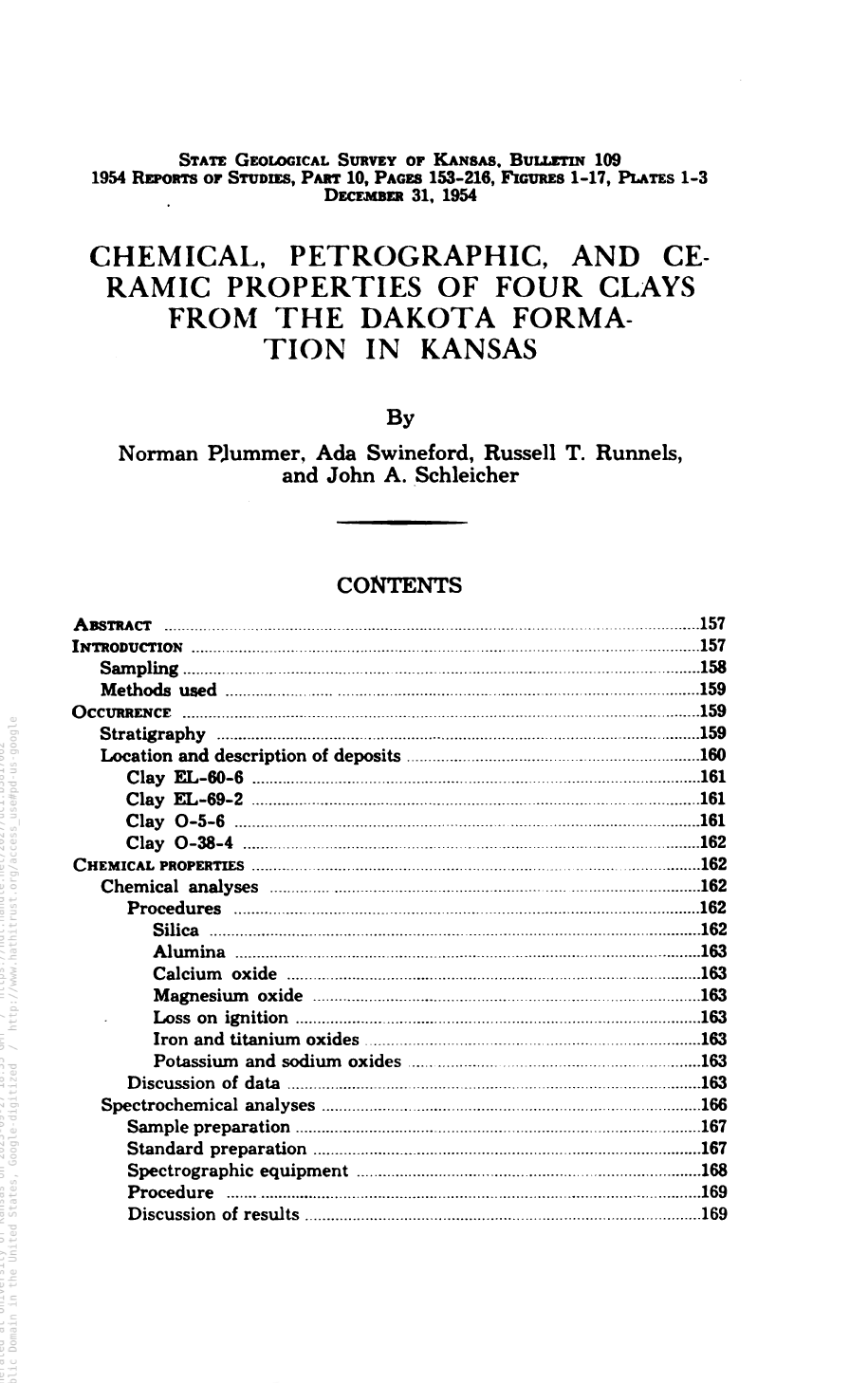
Chemical, Petrographic, and Ceramic Properties of Four Clays from the Dakota Formation in Kansas
DOI:
https://doi.org/10.17161/kgsbulletin.no.109.22091Abstract
Four commercial-type clays from the Dakota formation were studied by chemical and spectrochemical analysis, x-ray diffraction, electron and light microscopy, differential thermal analysis, mechanical analysis, and specific surface measurements. The basic chemical and physical properties so determined are compared with pH, apparent viscosity, and the results of empirical ceramic tests, including water of plasticity, shrinkage water, pore water, volume and linear shrinkage, fired color, pyrometric cone equivalent, saturation coefficient, apparent porosity, apparent and bulk specific gravity, and hardness at various fired temperatures.
Relationships between green properties and percentage water of plasticity and between green properties and specific surface are shown. The fired properties are shown to be more directly related to chemical and mineralogical composition. There is a correlation between percentage volume shrinkage on firing and percentage of fluxes contained in the clays. The basic properties explain the behavior of the clay materials when subjected to ceramic tests; and, conversely, easily obtained ceramic data can be used for rough determination of basic properties.
Downloads