Coal Resources of the Marmaton Group in Eastern Kansas
DOI:
https://doi.org/10.17161/kgsbulletin.no.114.22097Abstract
The Marmaton coal-bearing rocks lie directly above the "Cherokee" or main coal-bearing strata in southeastern Kansas and constitute the upper part of the middle Pennsylvanian rocks in Kansas. The coal-bearing rocks crop out in a belt 10 to 25 miles wide extending in a general northeast-southwest direction from Linn and Bourbon counties on the north to Montgomery and Labette counties on the south. Of the 8 to 10 coal seams in the group, only the Mulberry seam in the Bandera shale formation approximately in the middle of the group is being mined. A second coal seam, the Summit, in the Fort Scott limestone formation at the base of the Marmaton group is reported to have been mined although field evidence reveals no trace of mines nor outcrop of minable coal.
The Mulberry coal has been mined in Linn and Bourbon counties, but currently is mined commercially only in Linn County, which ranks third among the coal-producing counties of the State. The coal ranges in thickness from 1 to 4 feet where mined and is thickest in the northern and western parts of the coal-bearing area. The coal lies close to the surface and at depths reaching 120 feet. Currently, virtually all the coal is mined by stripping. The Mulberry is a bituminous coal of high volatile A to B rank. Proximate analyses show B.T.U. value on a moisture- and ash-free basis ranging from 14,200 to more than 15,000, which compares favorably with other Kansas commercial coals. The Mulberry coal can be used for all general purposes. It is estimated that 9,407,000 tons of Mulberry coal has been mined in Linn and Bourbon counties since 1872. Measured coal reserves are calculated at 221,230,000 tons, indicated reserves at 651,264,000 tons, and inferred reserves at 924,000,000 tons, a combined total of 1,796,490,000 tons of all reserve coal. Of the 221,230,000 tons of original measured reserves, 112,547,000 tons is considered recoverable by stripping and 16,649,000 tons minable by underground mining methods. The inferred coal reserves, which are estimated to underlie 703 square miles, extend into Miami, Allen, and Neosho counties.
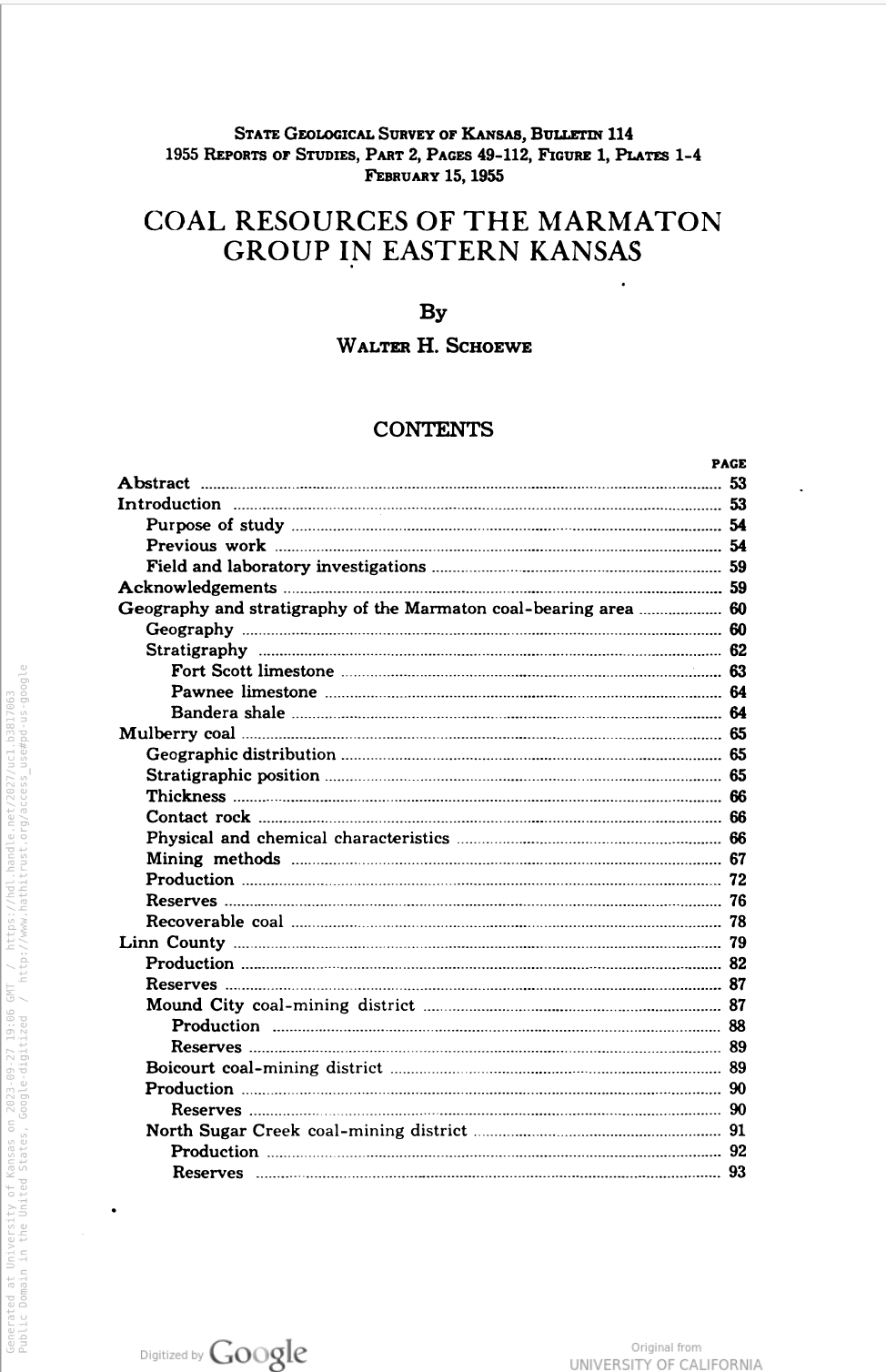
This report describes the geographic distribution, stratigraphic position, thickness, contact rock, and physical and chemical characters of the Mulberry coal and includes information on the history of Marmaton coal mining, mining methods, production, and coal reserve data. The report consists of two parts. The first part deals with the Mulberry coal in general, whereas the second discusses in detail the occurrence, mining, mining districts, production, and reserves in Linn and Bourbon counties.
Downloads