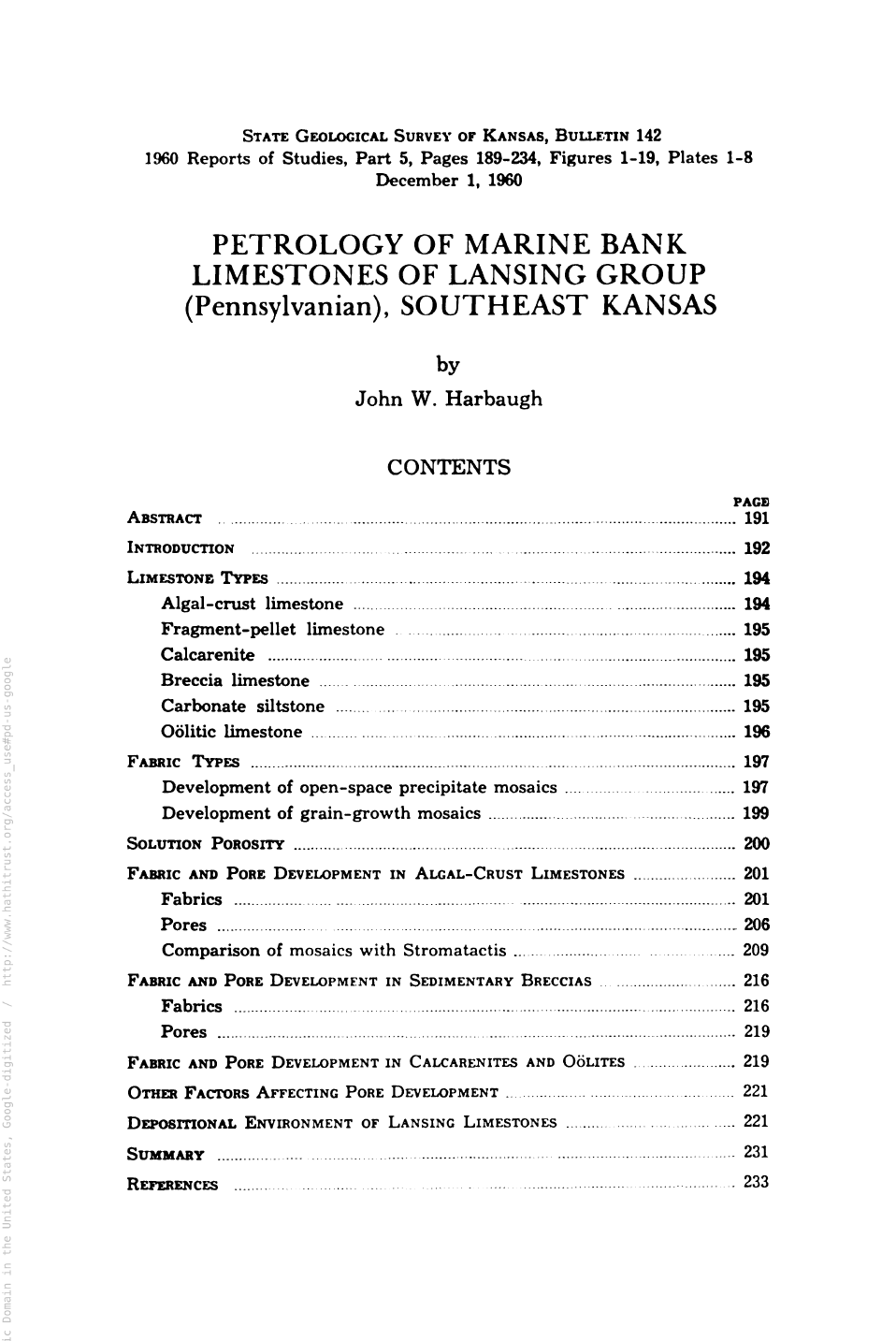
Petrology of Marine Bank Limestones of Lansing Group (Pennsylvanian), Southeast Kansas
DOI:
https://doi.org/10.17161/kgsbulletin.no.142.22157Abstract
Limestones of the Lansing Group in the Wilson-Montgomery County, Kansas, area contain small patches of coarsely crystalline calcite that exhibit two types of fabric, one formed by precipitation of calcium carbonate in cavities; the other by recrystallization of carbonate silt or fine skeletal debris by a process termed grain growth.
Filled cavities are associated with leaf-like fragments of algal crusts; which, during deposition, served as umbrellas, catching carbonate silt and skeletal debris on their upper surfaces and maintaining sheltered open spaces beneath. Cavities also were formed between fragments of partly consolidated carbonate silt that formed sedimentary breccias.
Algal crusts and fragments of other organisms tended to accumulate in thickened lenses or banks, which rose above the level of the surrounding sea floor and extended over many square miles. The banks were seemingly too poorly consolidated initially to have formed wave-resistant reefs.
Solution pores in Lansing limestone specimens obtained at outcrops show that small-scale lithologic features have exerted a large effect in localizing pores. Many pores occur within coarsely crystalline mosaics, particularly those formed as open-space precipitates. Other pores are localized at the boundaries of mosaics, at the contacts between individual skeletal particles, within algal crusts, and within dolomitized patches. Fractures, both large and small, also have had large influence in localizing pores. Development of porosity in buried Lansing limestones that serve as oil-reservoir rocks may be influenced similarly.
Downloads