Stratigraphic and Regional Trends in Chemistry and Quality of Natural Gas in Central and Western Kansas, Midcontinent, USA
DOI:
https://doi.org/10.17161/kgsbulletin.no.266.24930Keywords:
low-BTU gas, sour gas, gas migration, gas alteration, hydrocarbon gases, heliumAbstract
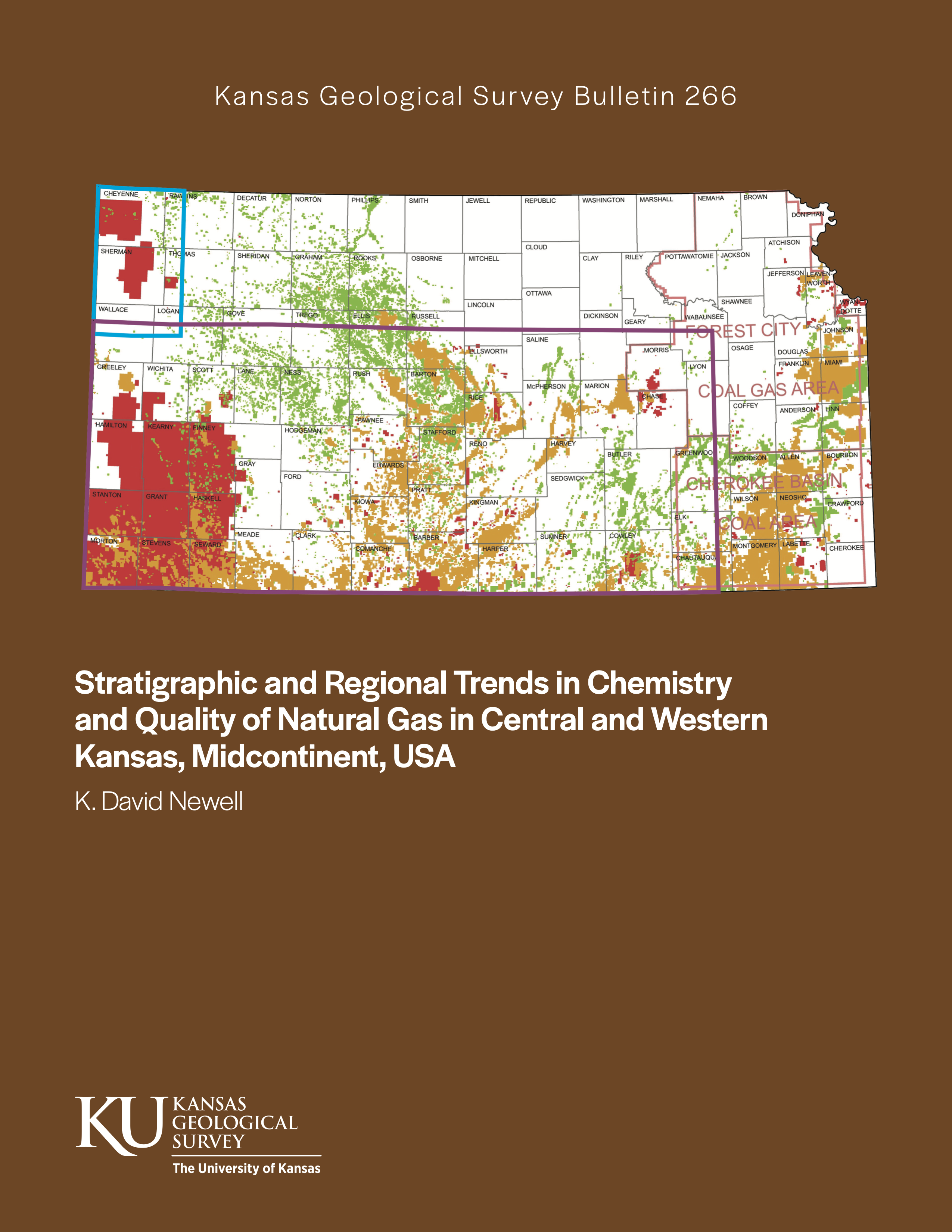
Natural gas from many midcontinent geological formations can contain significant quantities of nitrogen and subsidiary amounts of helium. Argon and carbon dioxide also can be present, but they commonly compose less than 0.5% of the total gas. In as many as a third of the fields in Kansas, noncombustible component gases reduce heating values to less than 950 BTU/scf.
Natural gas analyses, when differentiated into histograms according to their heat content (i.e., BTU/scf), array as skewed bell-shaped distributions with a “tail” on the lower-BTU flank of the distribution. There are no separate populations of low-BTU and high-BTU gases. The definition of a low-BTU gas is therefore somewhat arbitrary and artificial and mostly defined by what quality of natural gas will be accepted by pipeline companies. A gas with less than 950 BTU/scf — usually the minimum quality of gas accepted by pipelines without price discounts — is nominally identified as a low-BTU gas. Occurrences of low-BTU gas are geographically extensive in Kansas. Much of this low-BTU gas has either been shut in behind pipe or simply abandoned after discovery if it could not be blended with any readily available higher-BTU gas.
Most gas production in Kansas is from Permian Chase Group strata in the giant Hugoton Gas Field in southwestern Kansas. Elsewhere in the state, other Permian and older strata producing gas are associated with petroleum that was generated in and then migrated out of the Anadarko basin of Oklahoma. Cretaceous gases are present in the northwestern corner of the state. The Cretaceous gases are biogenic in origin and are updip of thermogenic gas occurrences in the Denver-Julesburg basin of Colorado and Wyoming.
Percentages of higher-molecular-weight hydrocarbon component gases (i.e., ethane, propane, butane, pentane, etc.) and helium generally decrease with decreasing age of the reservoir. Helium content is commonly linked to nitrogen content in a relatively constant ratio that generally increases with decreasing age of the reservoir. The median nitrogen/helium ratio for Kansas Cretaceous gases is 45/1. Median ratios for other strata are 31/1 for Permian strata, 25/1 for Pennsylvanian (Virgilian) strata, and 21/1 for Pennsylvanian (Missourian) strata. Gas-bearing zones along the basal Pennsylvanian angular unconformity have a median nitrogen/helium ratio of 11/1.
Some low-BTU regions in the Hugoton Gas Field and along the basal Pennsylvanian unconformity are possibly caused by interaction of the gases with formation water. Formation water could either leach the component gases, such as various hydrocarbon gases, from a natural gas accumulation or it could contribute component gases such as nitrogen and helium to a gas accumulation. Alternately, mixing with a lower-BTU gas also could alter the original composition of a natural gas accumulation.
The natural gas in the Chase Group of the Hugoton Gas Field in southwestern Kansas displays some consistent changes in composition. The perimeter of the field is characterized by low-BTU gas, and the perimeter is particularly wide in the northeastern corner of the field. For reasons unknown, gas analyses in the western (updip) part of the field assay with greater hydrocarbon wetness (i.e., greater percentages of higher-molecular-weight gases relative to methane) than gases in the eastern part of the field.
Helium content in natural gas accumulations increases from south to north and peaks on the southern part of the Central Kansas uplift. Maps of helium percentages and nitrogen/helium ratios define several areas where helium can be extracted to augment the economics of natural gas production in Kansas.
Downloads
Downloads
Published
Issue
Section
License
Copyright (c) 2025 K. David Newell

This work is licensed under a Creative Commons Attribution-NonCommercial 4.0 International License.