
First record of Rhinetula dentricus Friese (Hymenoptera: Halictidae: Halictini) from México
DOI:
https://doi.org/10.17161/jom.vi132.22426Abstract
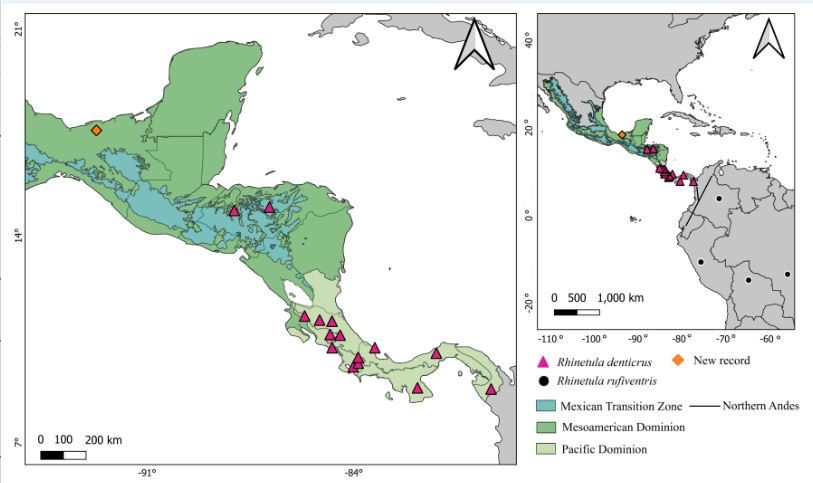
Rhinetula denticrus Friese is recorded for the first time in Mexico. During curatorial work, a specimen collected in 1980 from Cárdenas, Tabasco, Veracruz Biogeographic Province, was discovered, representing the northernmost known record of the genus in the Neotropical region. In addition, we provide new observations on the nesting habits of this species.
References
Ascher, J. S., & J. Pickering. 2023. Discover Life Bee Species Guides and World Checklist (Hymenoptera: Apoidea: Anthophila). [http://www.discoverlife.org/mp/20q?guide=Apoidea_species; accessed 20 Nov 2023].
Ayala, R., T. Griswold, & D. Yanega. 1996. Apoidea (Hymenoptera). In: Llorente, J., A.N. García-Aldrete, & E. González-Soriano, Eds. Biodiversidad, Taxonomía y Biogeografía de Artrópodos Mexicanos: Hacia una Síntesis de su Conocimiento: 423-464. Instituto Biología, UNAM; Ciudad de México, México; xii+660pp.
Basset, Y., V. Novotny, S.E. Miller, & R.L. Kitching. 2003. Arthropods of tropical forests: spatio-temporal dynamics and resource use in the canopy. Cambridge University Press; New York, USA; xvi+469 pp.
Corlett R.T., & R.B. Primack. 2011. Tropical rain forests: an ecological and biogeographical comparison [2ª edition] Wiley-Blackwell, Chichester, UK; x + 326 pp.
Danforth, B.N. 2002. Evolution of sociality in a primitively eusocial lineage of bees. Proceedings of the National Academy of Sciences 99(1): 286–290. https://www.pnas.org/doi/full/10.1073/pnas.012387999
Danforth, B.N., R.L. Minckley, & J.L. Neff. 2019. The solitary bees: biology, evolution, conservation. Princeton University Press; Princeton, NJ, USA; ix+488 pp.
Díaz‐Gallegos, J.R., J.F. Mas, & A. Velázquez. 2010. Trends of tropical deforestation in Southeast México. Singapore Journal of Tropical Geography 31(2): 180–196. https://doi.org/10.1111/j.1467-9493.2010.00396.x
Dinerstein, E., D.M. Olson, D.J. Graham, A.L. Webster, S.A. Primm, M.P. Bookbinder, & G. Ledec. 1995. A Conservation Assessment of the Terrestrial Ecoregions of Latin America and the Caribbean. World Wildlife Fund and World Bank; Washington, DC, USA; xvii+129 pp.
Flórez-Gómez, N., R. Ayala, I.A. Hinojosa-Díaz, & J.J. Morrone. 2022. The neotropical species of small carpenter bees of the subgenus Ceratina (Zadontomerus) Ashmead, 1899 (Hymenoptera: Apidae). Zootaxa 5214(2): 189–223. https://doi.org/10.11646/zootaxa.5214.2.3
Gonçalves, R.B., & G.A. Melo. 2006. Notes on the Neotropical bee genera Agapostemonoides Roberts & Brooks and Rhinetula Friese, with description of a new species of Agapostemonoides (Hymenoptera, Apidae, Halictinae). Zootaxa 1136(1): 39–48. https://doi.org/10.11646/zootaxa.1136.1.2
Gonçalves, R.B., & G.A. Melo. 2010. Phylogeny of the bee subtribe Caenohalictina Michener (Hymenoptera, Apidae sl, Halictinae sl). Zoologica Scripta 39(2): 187–197. https://doi.org/10.1111/j.1463-6409.2009.00414.x
Janjic, J. & L. Packer. 2003. Phylogeny of the bee genus Agapostemon (Hymenoptera: Halictidae). Systematic Entomology 28(1): 101–123. https://doi.org/10.1046/j.1365-3113.2003.00204.x
Mérida-Rivas, J.A., I.A. Hinojosa-Diaz, R. Ayala-Barajas, S. Barrientos-Villalobos, C. Pozo, & R. Vandame. 2022. Revision of carpenter bees of the subgenus Neoxylocopa Michener (Hymenoptera: Apidae) from México and Mesoamerica. Zootaxa 5158(1): 1–67. https://doi.org/10.11646/zootaxa.5158.1.1
Michener, C.D. 2007. The Bees of the World. [2ª edition] Johns Hopkins University Press, Baltimore, MD; xvi+[i]+953 pp.+20 pls.
Morrone, J.J. 2014. Biogeographical regionalisation of the Neotropical region. Zootaxa 3782(1): 1–110. https://doi.org/10.11646/zootaxa.3782.1.1
Myers, N. 2003. Biodiversity hotspots revisited. BioScience 53: 916–7. https://doi.org/10.1641/0006-3568(2003)053[0916:BHR]2.0.CO;2
Lyra, A., P. Imbach, D. Rodriguez, S.C. Chou, S. Georgiou, & L. Garofolo. 2017. Projections of climate change impacts on central America tropical rainforest. Climatic Change 14: 93–105. https://doi.org/10.1007/s10584-016-1790-2
Roberts, R.B. & R.W. Brooks. 1987. Agapostemonine bees of Mesoamerica (Hymenoptera: Halictidae). The University of Kansas Science Bulletin 53(7): 357–392. https://biostor.org/reference/40441
Roig-Alsina, A. 2024. The cleptoparasitic bee genus Odyneropsis in México (Hymenoptera, Apidae, Epeolini). Journal of Melittology (117): 1–9. https://doi.org/10.17161/jom.vi117.22379
Roubik, D.W. 1993. Tropical pollinators in the canopy and understory: field data and theory for stratum “preferences”. Journal of Insect Behavior 6: 659–673. https://doi.org/10.1007/BF01201668
Vivallo F., E. Vásquez-Lenis, & J. Mérida-Rivas. 2023. New species of Centris (Xanthemisia) Moure from the mesoamerican dominion and the mexican transition zone (Hymenoptera: Apidae). Zootaxa 5351: 341–355. http://dx.doi.org/10.11646/zootaxa.5351.3.3
Wcislo, W. T., & B.N. Danforth. 1997. Secondarily solitary: the evolutionary loss of social behavior. Trends in Ecology & Evolution 12(12): 468–474. https://doi.org/10.1016/S0169-5347(97)01198-1
Wolda, H., & D.W. Roubik. 1986. Nocturnal bee abundance and seasonal bee activity in a Panamanian forest. Ecology 67(2): 426–433. https://doi.org/10.2307/1938586
Zabinski, W. 2024. Andrena nimigracilis, a new species (Hymenoptera: Andrenidae) from México. Journal of Melittology (118): 1–9. https://doi.org/10.17161/jom.vi118.22244
Downloads
Published
Issue
Section
License
Copyright (c) 2025 ELDER A VÁSQUEZ LENIS, PHILIPPE SAGOT, JORGE A MÉRIDA-RIVAS, RÉMY VANDAME, CARLOS A CULTID MEDINA

This work is licensed under a Creative Commons Attribution-NonCommercial-NoDerivatives 4.0 International License.
Copyright for articles published in Journal of Melittology is retained by the authors, with first publication rights granted to the journal. By virtue of their appearance in this open access journal, articles are free to use, with proper attribution and permission of the authors, in educational and other non-commercial settings.