A review of the nest-entrance lurkers of meliponine bees (Hymenoptera: Apidae)
DOI:
https://doi.org/10.17161/jom.vi136.24216Abstract
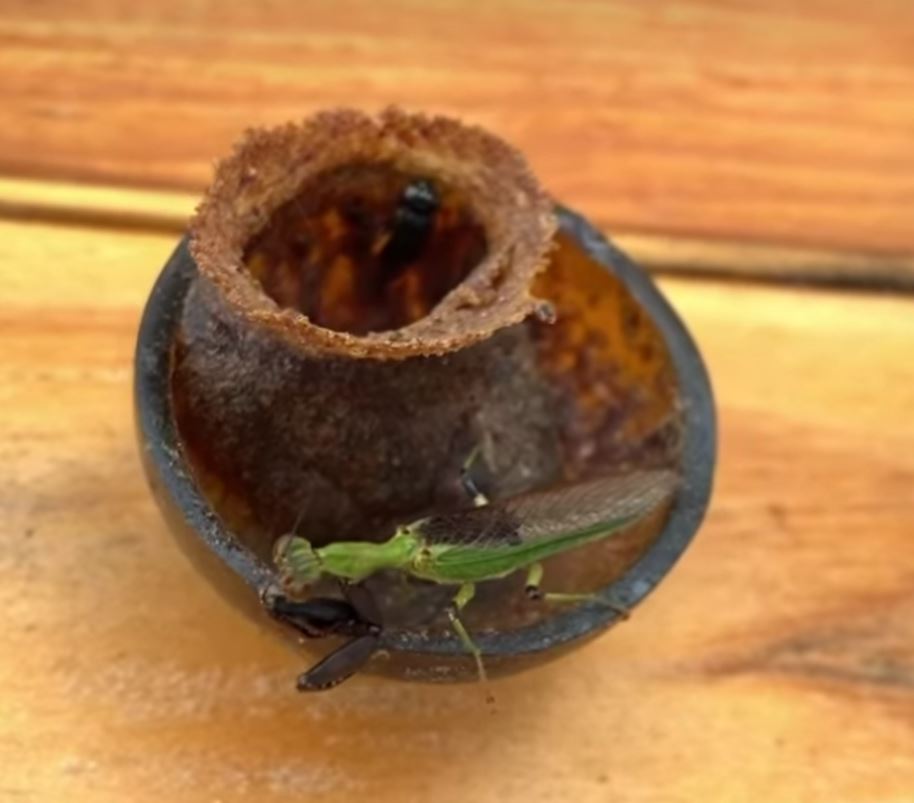
Stingless bees (Tribe Meliponini) are a group of considerable biological, economic, and cultural value. Despite their significance, information about their natural enemies remains limited, particularly regarding animals that lurk at the hive entrances and prey on bees entering and exiting the colonies. This study reviews the literature documenting these interactions. A total of 15 publications were compiled, detailing 41 records of 33 different organisms acting as nest-entrance ambushers. In addition, the mantid Acontista cordillerae Saussure & Zehntner (Mantodea: Acanthopidae) is reported for the first time ambushing bees at nests of Scaptotrigona mexicana (Guérin-Meneville) in a meliponary in central Veracruz, Mexico. The dynamics among the ambush predators and other social bees are discussed, including their defense strategies and nest structures.
References
Aldasoro-Maya, E.M., U. Rodríguez-Robles, M.L. Martínez-Gutiérrez, G.A. Chan-Mutul, T. Avilez-López, H. Morales, B.G. Ferguson, & J.A. Mérida-Rivas. 2023. Stingless bee keeping: Biocultural conservation and agroecological education. Frontiers in Sustainable Food Systems 6: 1081400. https://doi.org/10.3389/fsufs.2022.1081400
Ayala, R. 1999. Revisión de las abejas sin aguijón de México (Hymenoptera: Apidae: Meliponini). Folia Entomológica Mexicana 10(106): 1–123.
Boff, S., & A. Somavilla. 2024. Scientific note on a Neotropical wasp preying on stingless bees. Apidologie 55(21): 1–7. https://doi.org/10.1007/s13592-024-01063-x
Chaubey, S.N., R.S. Mishra, & P.R. Yadav. 2019. Studies on habit and habitat, external morphology, feeding capacity and prey preference of gray wall jumper spider, Menemerus bivittatus (Dufour). Journal of Experimental Zoology-India 22(2): 813–816.
Contreras-Cortés, L.E.U., A. Vázquez-García, E.M. Aldasoro-Maya, & J.A. Mérida-Rivas. 2020. Conocimiento de las abejas nativas sin aguijón y cambio generacional entre los Mayas lacandones de Nahá, Chiapas. Estudios de Cultura Maya 56: 205–225. https://doi.org/10.19130/iifl.ecm.2020.56.2.0008.
de MeloA, T.N., & D.S. Nogueira. 2020. Giant armadillo (Priodontes maximus Kerr, 1792; Cingulata: Chlamyphoridae) attacks nest of stingless bee Trigona amalthea (Olivier, 1789) (Hymenoptera: Apidae). Edentata 21: 38–41. https://doi.org/10.2305/IUCN.CH.2020.Edentata-20-1.6.en
Delgado, C., K. Mejía, C. Rasmussen, & R. Romero. 2023. Traditional knowledge of stingless bees (Hymenoptera: Apidae: Meliponini) in the Peruvian Amazon. Ethnobiology Letters 14(1): 1–9. https://doi.org/10.14237/ebl.14.1.2023.1772
Dubale, B.T., & T.G. Desha. 2022. Assessment of stingless bee (Apidae: Meliponini) production practices and Indigenous knowledge in West Arsi and Bale Zones of South-Eastern Oromia, Ethiopia. World Journal of Agricultural Science and Technology 1(1): 1–8. https://doi.org/10.11648/j.wjast.20230101.11
Dukas, R. 2005. Bumble bee predators reduce pollinator density and plant fitness. Ecology 86(6): 1401–1406. https://doi.org/10.1890/04-1663
Engel, M.S., C. Rasmussen, R. Ayala, & F.F. de Oliveira. 2023. Stingless bee classification and biology (Hymenoptera, Apidae): A review, with an updated key to genera and subgenera. ZooKeys 1172: 239–312. https://doi.org/10.3897/zookeys.1172.104944.
Filho, C.C.B., G.M.D.M. Santos, J.J. Resende, J.D. da Cruz, N. Gobbi, & V.L. Machado. 2009. Foraging behavior of the swarm-founding wasp, Polybia (Trichothorax) sericea (Hymenoptera, Vespidae): Prey capture and load capacity. Sociobiology 53(3): 899–907.
Gomes, L., G. Gomes, H.G. Oliveira, J.J. Morlin Junior, I.C. Desuó, I.M.D. Silva, & C.J. Von Zuben. 2007. Foraging by Polybia (Trichothorax) ignobilis (Hymenoptera, Vespidae) on flies at animal carcasses. Revista Brasileira de Entomologia 51(3): 389–393. https://doi.org/10.1590/S0085-56262007000300018.
Gopinatha, B.N., & S. Basavarajappa. 2022. Pests and predators interference on the stingless bee population inhabited at different habitats amidst south-eastern Karnataka, India. weather, Journal of Entomology and Zoology Studies 10(5): 191–202. https://doi.org/10.22271/j.ento.2022.v10.i5c.9059.
Grüter, C. 2020. Stingless Bees: Their behaviour, Ecology and Evolution. Springer Nature; Bristol, UK; xiv +385 pp., +97 pls.
Hines, H.M., S.A. Cameron, & A.R. Deans. 2007. Nest architecture and foraging behavior in Bombus pullatus (Hymenoptera: Apidae), with comparisons to other tropical bumble bees. Journal of the Kansas Entomological Society 80(1): 1–15. https://doi.org/10.2317/0022-8567(2007)80[1:NAAFBI]2.0.CO;2
Hrncir, M., S. Jarau, & F.G. Barth. 2016. Stingless bees (Meliponini): Senses and behavior. Journal of Comparative Physiology A 202: 597–601. https://doi.org/10.1007/s00359-016-1117-9
Jaapar, M.F., R. Jajuli, M.R. Mispan, & I.A. Ghani. 2018. Foraging behavior of stingless bee Heterotrigona itama (Cockerell, 1918) (Hymenoptera: Apidae: Meliponini). In AIP Conference proceedings 1940(1): 020037. https://doi.org/10.1063/1.5027952
Kajobe, R., & D.W. Roubik. 2006. Honey‐making bee colony abundance and predation by apes and humans in a Uganda forest reserve 1. Biotropica: The Journal of Biology and Conservation 38(2): 210–218. https://doi.org/10.1111/j.1744-7429.2006.00126.x
Koeniger, N., G. Koeniger, M. Gries, S. Tingek, & A. Kelitu. 1996. Observations on colony defense of Apis nuluensis Tingek, Koeniger and Koeniger, 1996 and predatory behavior of the hornet, Vespa multimaculata Pérez, 1910. Apidologie 27(5): 341–352. https://doi.org/10.1051/apido:19960502
Martínez, P.A., L.J. Alvarez, P.M. Garrido, D.P. Porrini, P.F. Muller, D. Alberoni, & M.P. Porrini. 2024. First record of Leptus spp. (Acari: Erythraeidae) parasitizing stingless bees (Apidae: Meliponini). Journal of Apicultural Research 63(2): 367–372. https://doi.org/10.1080/00218839.2023.2244719
McLennan, M.R. 2014. Chimpanzee insectivory in the northern half of Uganda’s Rift Valley: do Bulindi chimpanzees conform to a regional pattern?. Primates 55(2): 173–178. https://doi.org/10.1007/s10329-014-0408-4
Mduda, C.A., J.M. Hussein, & M.H. Muruke. 2023. Traditional knowledge and uses of stingless bees (Hymenoptera, Apidae, Meliponini) in Tanzania. International Journal of Tropical Insect Science 43(3): 1071–1088. https://doi.org/10.1007/s42690-023-01018-2
Menezes, C., A. Colleto-Silva, G.S. Gazêta, & W.E. Kerr. 2009. Infestation by Pyemotes tritici (Acari, Pyemotidae) causes death of stingless bee colonies (Hymenoptera: Meliponina). Genetics and Molecular Research 8(2): 630–634. https://doi.org/10.4238/vol8-2kerr021
Nogueira-Neto, P. 1997. Vida e Criação de Abelhas Indígenas Sem Ferrão. Editorial Nogueirapis; São Paulo, Brasil; 445 pp.
Ono, M., I. Okada, & M. Sasaki. 1987. Heat production by balling in the Japanese honeybee, Apis cerana japonica as a defensive behavior against the hornet, Vespa simillima xanthoptera (Hymenoptera: Vespidae). Experientia 43(1): 1031–1034. https://doi.org/10.1007/BF01952231
Quezada-Euán, J.J.G., G. Nates-Parra, M.M. Maués, D.W. Roubik, & V.L. Imperatriz-Fonseca. 2018. The economic and cultural values of stingless bees (Hymenoptera: Meliponini) among ethnic groups of tropical America. Sociobiology 65(4): 534–557. https://doi.org/10.13102/sociobiology.v65i4.3447
Razakamiaramanana, A.N., O. Ihsane, M. Héger, M. Aganze Mweze, R.H. Karanja, J.R. Randriamalala, O.L. Rakotondrasoa, A. Russell-Smith, K. Nkoba, N. Warrit, & N.J. Vereecken. 2025. Meliponophagy: New records involving native and exotic jumping spiders (Araneae, Salticidae) preying upon stingless bees (Apidae, Meliponini) in the Afrotropical realm. African Journal of Ecology 63(7): e70110. https://doi.org/10.1111/aje.70110
Reyes-González, A., A. Camou-Guerrero, O. Reyes-Salas, A. Argueta, & A. Casas. 2014. Diversity, local knowledge and use of stingless bees (Apidae: Meliponini) in the municipality of Nocupétaro, Michoacán, México. Journal of Ethnobiology and Ethnomedicine 47(10): 1–12. https://doi.org/10.1186/1746-4269-10-47
Roubik, D.W. 2023. Stingless bee (Apidae: Apinae: Meliponini) ecology. Annual Review of Entomology 68(1): 231–256. https://doi.org/10.1146/annurev-ento-120120-103938
Tan, K., S.E. Radloff, J.J. Li, H.R. Hepburn, M.X. Yang, L.J. Zhang, & P. Neumann. 2007. Bee-hawking by the wasp, Vespa velutina, on the honeybees Apis cerana and A. mellifera. Naturwissenschaften 94: 469–472. https://doi.org/10.1007/s00114-006-0210-2
Trindade-Santos, M.E., R.L. Ramos, T.S. Melo, A.D. Brescovit, & F.F. de Oliveira. 2023. Exotic and predatory: A spider (Araneae: Salticidae) that preys on native stingless bees (Hymenoptera: Meliponini) in Brazil. Revista Chilena de Entomología 49(4): 701–706. https://doi.org/10.35249/rche.49.4.23.04
Vyas, R. 2012. Notes on interaction between northern house gecko Hemidactylus flaviviridis (Reptilia: Squamata) and stingless bee (Trigona iridipennis) (Hymenoptera: Apidae: Meliponini). Russian Journal of Herpetology 19(1): 65–69. https://doi.org/10.30906/1026-2296-2012-19-1-65–69
Wattanachaiyingcharoen, W., & T. Jongjitvimol. 2007. First record of the predator, Pahabengkakia piliceps Miller, 1941 (Reduviidae, Harpactorinae) in the stingless bee, Trigona collina Smith, 1857 (Apidae, Meliponinae) in Thailand. Tropical Natural History 7(1): 71–74. https://doi.org/10.58837/tnh.7.1.102921
Wcislo, W.T., & B. Schatz. 2003. Predator recognition and evasive behavior by sweat bees, Lasioglossum umbripenne (Hymenoptera: Halictidae), in response to predation by ants, Ectatomma ruidum (Hymenoptera: Formicidae). Behavioral Ecology and Sociobiology 53: 182–189. https://doi.org/10.1007/S00265-002-0564-1
Wcislo, W.T., L. Arneson, K. Roesch, V. Gonzalez, A. Smith, & H. Fernández. 2004. The evolution of nocturnal behaviour in sweat bees, Megalopta genalis and M. ecuadoria (Hymenoptera: Halictidae): An escape from competitors and enemies?. Biological Journal of the Linnean Society 83(3): 377–387. https://doi.org/10.1111/j.1095-8312.2004.00399.x
Zamudio, F., & N.I. Hilgert. 2015. Multi-dimensionality and variability in folk classification of stingless bees (Apidae: Meliponini). Journal of Ethnobiology and Ethnomedicine 41(11): 1–16. https://doi.org/10.1186/s13002-015-0029-z
Downloads
Additional Files
Published
Issue
Section
License
Copyright (c) 2025 Gerardo Quintos-Andrade

This work is licensed under a Creative Commons Attribution-NonCommercial-NoDerivatives 4.0 International License.
Copyright for articles published in Journal of Melittology is retained by the authors, with first publication rights granted to the journal. By virtue of their appearance in this open access journal, articles are free to use, with proper attribution and permission of the authors, in educational and other non-commercial settings.