
A new species of Andrena (Labergeia) from Texas with an unusual phenology and floral host, including a redescription of Labergeia (Hymenoptera: Andrenidae)
DOI:
https://doi.org/10.17161/jom.vi141.24606Abstract
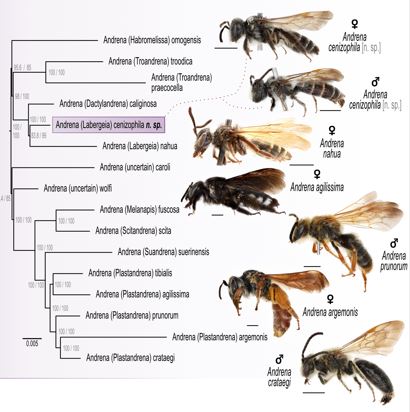
Andrena is a species-rich genus of bees with a wide distribution, predominantly in the Holarctic. Here, we describe and illustrate a previously unknown species, Andrena (Labergeia) cenizophila Neff, Bossert & Zabinski n. sp., from southwestern Texas and central Coahuila, Mexico. Phylogenomic analyses recovered the new species as most closely related to Andrena (Labergeia) nahua Neff, a central Mexican species that was hitherto known only from the male sex. The discovery and examination of additional specimens of A. nahua allows us to describe and illustrate the previously unknown female, which shares diagnostic morphological features with the female of A. cenizophila n. sp. Based on these insights, we expand the diagnosis of Labergeia Neff to accommodate both species and discuss morphological affinities with their closest relatives in the subgenus Dactylandrena Viereck. Fossil-informed divergence time estimates indicates that Labergeia originated in the late Miocene, around 8 million years ago (5.37–11.82 mya), and that all known species of the subgenus, as well as its sister lineage Dactylandrena, are distributed in western and/or central North American. Lastly, we discuss the unusual foraging biology of A. cenizophila n. sp., which, based on observations and analyses of scopal pollen loads, is an oligolege of Leucophyllum frutescens (Berl.), I. M. Johnst. (Scrophulariaceae), a shrub commonly known as cenizo, Texas ranger, or Texas purple sage, among others. Interestingly, cenizo has a distinct floral phenology with comparatively short-termed mass blooms of not more than a week in duration, rendering it an unexpected choice for a specialist pollen collector. To our knowledge, A. cenizophila n. sp., is the only New World Andrena species that is oligolectic on plants of the family Scrophulariaceae.
References
Bossert, S. 2017. Description of the female of Clavinomia clavicornis (Warncke, 1980) (Halictidae: Nomiinae), with the species’ taxonomy and first record from the Arabian Peninsula. Pan-Pacific Entomologist 93(1): 29–34. https://doi.org/10.3956/2017-93.1.29
Bossert, S., E.A. Murray, B.B. Blaimer, & B.N. Danforth. 2017. The impact of GC bias on phylogenetic accuracy using targeted enrichment phylogenomic data. Molecular Phylogenetics and Evolution 111: 149–157. https://doi.org/10.1016/j.ympev.2017.03.22
Bossert, S., & B.N. Danforth. 2018. On the universality of target enrichment baits for phylogenomic research. Methods in Ecology and Evolution 9(6): 1453–1460. https://doi.org/1111/2041-210X.12988
Bossert, S., E.A. Murray, A. Pauly, K. Chernyshov, S.G. Brady, & B.N. Danforth. 2021. Gene tree estimation error with ultraconserved elements: An empirical study on Pseudapis bees. Systematic Biology 70(4): 803–821. https://doi.org/10.1093/sysbio/syaa097
Bossert, S., T.J. Wood, S. Patiny, D. Michez, E.A.B. Almeida, R.L. Minckley, L. Packer, J.L. Neff, R.S. Copeland, J. Straka, A. Pauly, T. Griswold, S.G. Brady, B.N. Danforth, & E.A. Murray. 2022. Phylogeny, biogeography and diversification of the mining bee family Andrenidae. Systematic Entomology 47(2): 283–302. https://doi.org/10.1111/syen.12530
Bossert, S., K.-L.J. Hung, & J.L. Neff. 2024a. Evolutionary history and ecology of Andrena (Foveoandrena) androfovea: a new nearctic mining bee (Hymenoptera, Andrenidae) species and subgenus. Ecology and Evolution 14(11): e70453. https://doi.org/10.1002/ece3.70453
Bossert, S., A. Pauly, B.N. Danforth, M.C. Orr, & E.A. Murray. 2024b. Lessons from assembling UCEs: A comparison of common methods and the case of Clavinomia (Halictidae). Molecular Ecology Resources 24(3): e13925. https://doi.org/10.1111/1755-0998.13925
Bouseman, J.K., & W.E. LaBerge. 1978. A revision of the bees of the genus Andrena of the western hemisphere. Part IX. Subgenus Melandrena. Transactions of the American Entomological Society 104(3/4): 275–389. https://jstor.org/stable/i25078225
Branstetter, M.G., J.T. Longino, P.S. Ward, & B.C. Faircloth. 2017. Enriching the ant tree of life: Enhanced UCE bait set for genome-scale phylogenetics of ants and other Hymenoptera. Methods in Ecology and Evolution 8(6): 768–776. https://doi.org/10.1111/2041-210X.12742
Buchmann, S.L. & M.K. O’Rourke. 1991. Importance of pollen grain volumes for calculating bee diets. Grana 30:591-595. https://doi.org/10.1080/00173139109427817
Cane, J.H. 1987. Estimation of bee size using intertegular span (Apoidea). Journal of the Kansas Entomological Society 60(1): 145–147. https://www.jstor.org/stable/25084877
Degnan, J.H., & L.A. Salter. 2005. Gene tree distributions under the coalescent process. Evolution 59(1): 24–37. https://www.jstor.org/stable/3448993
Dubitzky, A., J. Plant, & K. Schönitzer. 2010. Phylogeny of the bee genus Andrena Fabricius based on morphology. Mitteilungen der Münchner Entomologischen Gesellschaft 100: 137–202.
Faircloth, B.C., M.G. Branstetter, N.D. White, & S.G. Brady. 2015. Target enrichment of ultraconserved elements from arthropods provides a genomic perspective on relationships among Hymenoptera. Molecular Ecology Resources 15(3): 489–501. https://doi.org/10.1111/1755-0998.12328
Giovanetti, M., & E. Lasso. 2005. Body size, loading capacity and rate of reproduction in the communal bee Andrena agilissima (Hymenoptera; Andrenidae). Apidologie 36(3): 439–447. https://doi.org/10.1051/apido:2005028
Grab, H., M.G. Branstetter, N. Amon, K.R. Urban-Mead, M.G. Park, J. Gibbs, E.J. Blitzer, K. Poveda, G. Loeb, & B.N. Danforth. 2019. Agriculturally dominated landscapes reduce bee phylogenetic diversity and pollination services. Science 363(6424): 282–284. https://doi.org/10.1126/science.aat6016
Hendrickson, J., & L.D. Flyr. 1985. Systematics of Leucophyllum and Eremogeton (Scrophulariaceae). Sida 11(2): 107–172. https://www.jstor.org/stable/23909310
Hirashima, Y. 1964. Systematic and biological studies of the family Andrenidae of Japan (Hymenoptera, Apoidea) Part 2. Systematics, 4. Journal of the Faculty of Agriculture, Kyushu University 13(1): 71–97.
Kirby, W. 1837. Part IV, Insects. In: Richardson, J. (Ed.), Boreali-Americana; or the zoology of the northern parts of British America. Longman; London; 325 pp.
Kolaczkowski, B., & J.W. Thornton. 2004. Performance of maximum parsimony and likelihood phylogenetics when evolution is heterogeneous. Nature 431(7011): 980–984. https://doi.org/10.1038/nature02917
LaBerge, W.E. 1967. A revision of the bees of the genus Andrena of the Western Hemisphere. Part I. Callandrena (Hymenoptera: Andrenidae). Bulletin of The University of Nebraska State Museum 7: 1–318.
LaBerge, W.E. 1969. A revision of the bees of the genus Andrena of the Western Hemisphere. Part II. Plastandrena, Aporandrena, Charitandrena. Transactions of the American Entomological Society 95(1): 1–47. https://jstor.org/stable/25077972
LaBerge, W.E. 1971. A revision of the bees of the genus Andrena of the Western Hemisphere. Part IV. Scrapteropsis, Xiphandrena and Rhaphandrena. Transactions of the American Entomological Society 97(3): 441–520. https://jstor.org/stable/25078019
LaBerge, W.E. 1973. A revision of the bees of the genus Andrena of the Western Hemisphere. Part VI. Subgenus Trachandrena. Transactions of the American Entomological Society 99(3): 235–371. https://jstor.org/stable/i25078130
LaBerge, W.E. 1977. A revision of the bees of the genus Andrena of the Western Hemisphere. Part VIII. Subgenera Thysandrena, Dasyandrena, Psammandrena, Rhacandrena, Euandrena, Oxyandrena. Transactions of the American Entomological Society 103(1): 1–143. https://jstor.org/stable/25078201
LaBerge, W.E. 1980. A revision of the bees of the genus Andrena of the Western Hemisphere. Part X. Subgenus Andrena. Transactions of the American Entomological Society 106(4): 395–525. https://jstor.org/stable/25078270
LaBerge, W.E. 1985. A revision of the bees of the genus Andrena of the Western Hemisphere. Part XI. Minor subgenera and subgeneric key. Transactions of the American Entomological Society 111(4): 441–567. 441–567. https://jstor.org/stable/i25078372
LaBerge, W.E. 1986. A revision of the bees of the genus Andrena of the Western Hemisphere. Part XII. Subgenera Leucandrena, Ptilandrena, Scoliandrena and Melandrena. Transactions of the American Entomological Society 112(3): 191–248. https://jstor.org/stable/i25078389
LaBerge, W.E. 1989. A revision of the bees of the genus Andrena of the Western Hemisphere. Part XIII. Subgenera Simandrena and Taeniandrena. Transactions of the American Entomological Society 115(1): 1–56. https://jstor.org/stable/i25078372
LaBerge, W.E., & D.W. Ribble. 1972. A revision of the bees of the genus Andrena of the Western Hemisphere. Part V. Gonandrena, Geissandrena, Parandrena, Pelicandrena. Transactions of the American Entomological Society 98(3): 271–358. https://jstor.org/stable/25078115
LaBerge, W.E., & D.W. Ribble. 1975. A revision of the bees of the genus Andrena of the Western Hemisphere. Part VII. Subgenus Euandrena. Transactions of the American Entomological Society 101(3): 371–446. https://jstor.org/stable/25078177
LaBerge, W.E., & J.K. Bouseman. 1970. A revision of the bees of the genus Andrena of the Western Hemisphere. Part III. Tylandrena. Transactions of the American Entomological Society 96(4): 543–605. https://jstor.org/stable/i25077999
LaBerge, W.E., & R.W. Thorp. 2005. A revision of the bees of the genus Andrena of the Western Hemisphere: Part XIV—Subgenus Onagrandrena. Illinois Natural History Survey Bulletin 37(1): 1–63. https://doi.org/10.21900/j.inhs.v37.119
Larkin, L.L. 2004. Four new fall species of Andrena from the southwestern United States (Hymenoptera: Andrenidae). Journal of the Kansas Entomological Society 77(3): 254–268. https://www.jstor.org/stable/25086214
Maddison, W.P. 1997. Gene trees in species trees. Systematic Biology 46(3): 523–536. https://doi.org/10.2307/2413694
Manni, M., M.R. Berkeley, M. Seppey, F.A. Simão, & E.M. Zdobnov. 2021. BUSCO update: novel and streamlined workflows along with broader and deeper phylogenetic coverage for scoring of eukaryotic, prokaryotic, and viral genomes. Molecular Biology and Evolution 38(10): 4647–4654. https://doi.org.1093/molbev/msab199
Michener, C. D. 1944. Comparative external morphology, phylogeny, and a classification of the bees (Hymenoptera). Bulletin of the American Museum of Natural History. 82 (6): 151–326. http://hdl.handle.net/2246/1272
Neff, J.L. 2024. Andrena nahua, a new bee species from central Mexico (Hymenoptera: Andrenidae: Andreninae). Journal of Melittology 116: 1–7. https://doi.org/10.17161/jom.116.12718
Neff, J.L., & L.L. Larkin. 2002. Andrena chaparralensis new species, a new vernal bee associated with Asteraceae on the south Texas plains (Hymenoptera: Apoidea: Andrenidae). Journal of the Kansas Entomological Society: 75 268–273. https://www.jstor.org/stable/25481786
Niezgoda, C.J. & A.S. Tomb. 1975. Systematic palynology of the tribe Leucophylleae (Scophulariaceae) and selected Myoporaceae. Pollen et Spores 17 :495–516.
Pisanty, G., R. Richter, T. Martin, J. Dettman, & S. Cardinal. 2022. Molecular phylogeny, historical biogeography and revised classification of andrenine bees (Hymenoptera: Andrenidae). Molecular Phylogenetics and Evolution 170: 107151. https://doi.org/10.1016/j.ympev.2021.107157
Pohl, T.J., & L.L. Larkin. 2006. A new species of Andrena (Hymenoptera: Andrenidae) from Mexico. Journal of the Kansas Entomological Society 79(2): 107–112. https://www.jstor.org/stable/25086309
POWO. 2025. Plants of the World Online. Facilitated by the Royal Botanic Gardens, Kew. [https://powo.science.kew.org/; last accessed 5 December 2025].
Prjibelski, A., D. Antipov, D. Meleshko, A. Lapidus, & A. Korobeynikov. 2020. Using SPAdes de novo assembler. Current Protocols in Bioinformatics 70(1): e102. https://doi.org/10.1002/cpbi.102
Roure, B., & H. Philippe. 2011. Site-specific time heterogeneity of the substitution process and its impact on phylogenetic inference. BMC Evolutionary Biology 11(1): 1–14. https://doi.org/10.1186/1471-2148-11-17
Sheffield, C.S. 2020. A new species of Andrena (Trachandrena) from the southwestern United States (Hymenoptera, Andrenidae). Journal of Hymenoptera Research 77: 87–103. https://doi.org/10.3897/jhr.77.53704
Shorthouse, D.P. 2010. SimpleMappr, an online tool to produce publication-quality point maps. [https://www.simplemappr.net/; last accessed 19 September 2025].
Smith, F., 1853. Catalogue of Hymenopterous Insects in the Collection of the British Museum. Part I. Andrenidae and Apidae. Printed by Order of the Trustees; London, UK; 465 pp.
Tamura, K., F.U. Battistuzzi, P. Billing-Ross, O. Murillo, A. Filipski, & S. Kumar. 2012. Estimating divergence times in large molecular phylogenies. Proceedings of the National Academy of Sciences 109(47): 19333–19338. https://doi.org/10.1073/pnas.1213199109
Thorp, R.W., & W.E. LaBerge. 2005. A revision of the bees of the genus Andrena of the Western Hemisphere Part XV. Subgenus Hesperandrena. Illinois Natural History Survey Bulletin 37(2): 65–93. https://doi.org/10.21900/j.inhs.v37
Wood, T.J. 2024. New Asian Andrena species, with notes on the subgenus Cnemidandrena (Hymenoptera: Andrenidae). Zootaxa 5404(1): 167–188. https://doi.org.10.11646/zootaxa.5404.1.11
Wood, T.J.,M. Boustani & P. Rasmont. 2020. A revision of the Andrena (Hymenoptera: Andrenidae) of Lebanon with the description of six new species. Annales de la Societe entomologique du France (N.S.) 56(4): 279–312. https://doi.org/10.1080/00379271.2020.1794960
Zabinski, W.J. 2024. Andrena nimigracilis, a new species (Hymenoptera: Andrenidae) from México. Journal of Melittology 118: 1–9. https://doi.org/10.10.17161/jom.vi118.22244
Downloads
Published
Issue
Section
License
Copyright (c) 2026 Silas Bossert, Wyatt Zabinski, John L Neff

This work is licensed under a Creative Commons Attribution-NonCommercial-NoDerivatives 4.0 International License.
Copyright for articles published in Journal of Melittology is retained by the authors, with first publication rights granted to the journal. By virtue of their appearance in this open access journal, articles are free to use, with proper attribution and permission of the authors, in educational and other non-commercial settings.