
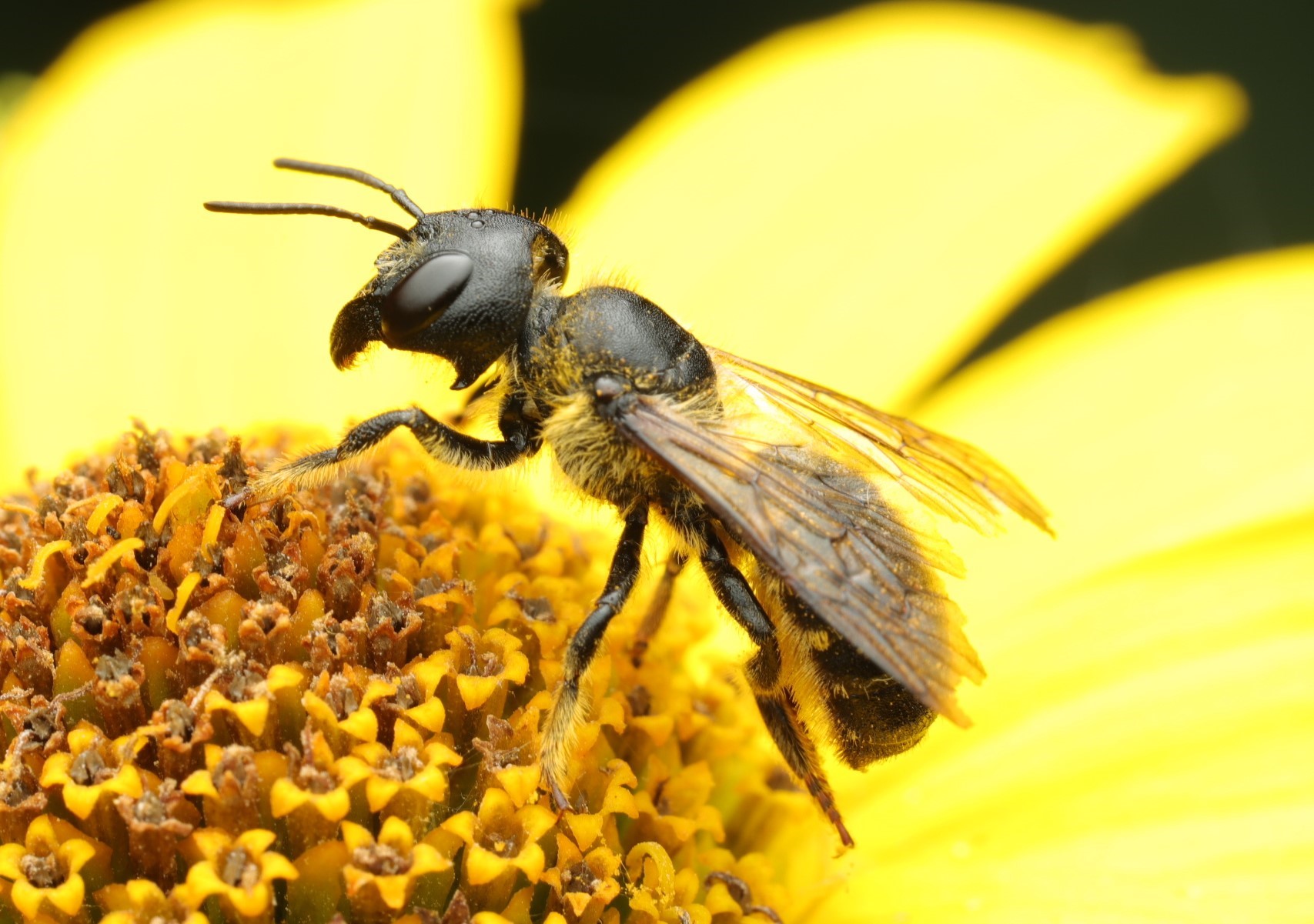
An eagerness for conspecifics: The distribution of nests of the sunflower leafcutting bee, Megachile pugnata (Megachilidae), when nesting cavities are in excess
DOI:
https://doi.org/10.17161/jom.vi140.24208Abstract
Under unmanaged conditions, many ground-nesting bee species nest in large aggregations. Although cavity-nesters (xylophiles) will also nest in large aggregations when managed in agricultural settings, it is unclear if they do so instinctively or due to opportunity. Here we report that females of the xylophile Megachile pugnata Say preferentially aggregate their nests at three measured scales of cavity availability even when nesting cavities are in excess. We also find that they sometimes prefer to initiate nesting at the edges of nesting blocks but that they are generally unresponsive to the position of cavities in nest shelters: aggregations are evident irrespective of location. We propose that an important but previously unemphasized reason that aggregation behavior has been maintained by xylophiles and ground-nesting species, is the genetic benefits realized by having many unrelated mating partners available.
References
Bengtsson, J. 2008. Aggregation in non-social insects. Växtskyddsbiologi, Sveriges lantbruksuniversitet. Alnarp, Sweden, pp.1–18. https://core.ac.uk/download/pdf/11695796.pdf
Cane, J.H., & J.L. Neff. 2011. Predicted fates of ground-nesting bees in soil heated by wildfire: Thermal tolerances of life stages and a survey of nesting depths. Biological conservation 144(11): 2631–2636. https://doi.org/10.1016/j.biocon.2011.07.019
Chittka, L., & N. Rossi. 2022. Social cognition in insects. Trends in Cognitive Sciences 26(7): 578–592. https://doi.org/10.1016/j.tics.2022.04.001
Danforth, B.N., R.L. Minckley, & J.L. Neff. 2019. The Solitary Bees: Biology, Evolution, Conservation. Princeton University Press; Princeton NJ; xi+472 pp. DOI: 10.1515/9780691197043
Eickwort, G.C., R.W. Matthews, & J. Carpenter. 1981. Observations on the nesting behavior of Megachile rubi and M. texana with a discussion of the significance of soil nesting in the evolution of megachilid bees (Hymenoptera: Megachilidae). Journal of the Kansas Entomological Society 54(3): 557–570. http://www.jstor.org/stable/25084194
Fauria, K., R. Campan, & A. Grimal. 2004. Visual marks learned by the solitary bee Megachile rotundata for localizing its nest. Animal Behaviour 67(3): 523–530. https://doi.org/10.1016/j.anbehav.2003.06.002
Frolich, (sic) D.R., & F.D. Parker. 1983. Nest building behavior and development of the sunflower leafcutter bee: Eumegachile (Sayapis) pugnata (Say) (Hymenoptera: Megachilidae). Psyche 90(3): 193–209. https://doi.org/10.1155/1983/28573
Groulx, A.F., & J.R.K. Forrest. 2018. Nesting aggregation as a predictor of brood parasitism in mason bees (Osmia spp.). Ecological Entomology 43(2):182–191. https://doi.org/10.1111/een.12484
Guédot, C., J. Bosch, R.R. James, & W.P. Kemp. 2006. Effects of three-dimensional and color patterns on nest location and progeny mortality in alfalfa leafcutting bee (Hymenoptera: Megachilidae). Journal of Economic Entomology 99(3): 626–633. https://doi.org/10.1093/jee/99.3.626
Hamilton, W.D. 1971. Geometry for the selfish herd. Journal of Theoretical Biology 31(2): 295–311. https://doi.org/10.1016/0022-5193(71)90189-5
Harmon-Threatt, A. 2020. Influence of nesting characteristics on health of wild bee communities. Annual Review of Entomology 65(1): 39–56. https://doi.org/10.1146/annurev-ento-011019-024955
Hefetz, A., & J. Tengo. 1992. Dispersed versus gregarious nesting strategies in the mason bee, Chalicodoma siculum. Journal of Zoology, London 226(4): 529–537. https://doi.org/10.1111/j.1469-7998.1992.tb07496.x
Kocher, S.D., R. Mallarino, B.E. Rubin, D.W. Yu, H.E. Hoekstra, & N.E. Pierce. 2018. The genetic basis of a social polymorphism in halictid bees. Nature Communications 9(1): 4338. https://doi.org/10.1038/s41467-018-06824-8
Krebs, C.J. 1999. Ecological Methodology. 2nd ed. Benjamin/Cummings; New York NY; 620pp.
Krombein, K.V. 1967.Trap-Nesting Wasps and Bees: Life Histories, Nests, and Associates. The Smithsonian Institution. Smithsonian Publ. 4670. Washington, DC; vi+570 pp
Litman, J.R., B.N. Danforth, C.D. Eardley, & C.J. Praz. 2011. Why do leafcutter bees cut leaves? New insights into the early evolution of bees. Proceedings of the Royal Society B: Biological Sciences 278(1724): 3593–3600. https://doi.org/10.1098/rspb.2011.0365
Loukola, O.J., E. Gatto, A.C. Hijar-Islas & L. Chittka. 2020. Selective interspecific information use in the nest choice of solitary bees. Animal Biology 70: 215–225. https://doi.org/10.1163/15707563-20191233
Michener, C.D. 1964. Evolution of the nests of bees. American Zoologist 4(2): 227–239. http://www.jstor.org/stable/3881295
Michener, C.D. 1974. The Social Behavior of the Bees: A Comparative Study. Harvard University Press; Cambridge, MA; xii+404 pp.
Morato, E.F., & R.P. Martins. 2006. An overview of proximate factors affecting the nesting behavior of solitary wasps and bees (Hymenoptera: Aculeata) in preexisting cavities in wood. Neotropical Entomology 35(3): 285–298. https://doi.org/10.1590/s1519-566x2006000300001
Osterman, J., M.A. Aizen, J.C. Biesmeijer, J. Bosch, B.G. Howlett, D.W. Inouye, C. Jung, D.J. Martins, R. Medel, A. Pauw, & C.L. Seymour. 2021. Global trends in the number and diversity of managed pollinator species. Agriculture, Ecosystems & Environment 322: 107653. https://doi.org/10.1016/j.agee.2021.107653
Parker, F.D., & D.R. Frohlich. 1985. Studies on management of the sunflower leafcutter bee Eumegachile pugnata (Say) (Hymenoptera: Megachilidae). Journal of Apicultural Research 24(2): 125–131. https://doi.org/10.1080/00218839.1985.11100660
Parrish, J.K., & L. Edelstein-Keshet. 1999. Complexity, pattern, and evolutionary trade-offs in animal aggregation. Science 284(5411): 99–101. https://doi.org/10.1126/science.284.5411.99
Paxton, R.J. 2005. Male mating behaviour and mating systems of bees: An overview. Apidologie 36(2): 145–156. DOI: https://doi.org/10.1051/apido:2005007
Paxton, R.J., P.A. Thorén, J. Tengö, A. Estoup, & P. Pamilo. 1996. Mating structure and nestmate relatedness in a communal bee, Andrena jacobi (Hymenoptera, Andrenidae), using microsatellites. Molecular Ecology 5(4): 511–519. https://doi.org/10.1046/j.1365-294X.1996.00117.x
Pitts-Singer, T.L., & J.H. Cane. 2011. The alfalfa leafcutting bee, Megachile rotundata: The world's most intensively managed solitary bee. Annual Review of Entomology 56(1): 221–237. https://doi: 10.1146/annurev-ento-120709-144836
Potts, S.G,. & P. Willmer. 1997. Abiotic and biotic factors influencing nest-site selection by Halictus rubicundus, a ground-nesting halictine bee. Ecological Entomology 22(3): 319–328. https://doi.org/10.1046/j.1365-2311.1997.00071.x
Richards, M.H., E.J. von Wettberg, & A.C. Rutgers. 2003. A novel social polymorphism in a primitively eusocial bee. Proceedings of the National Academy of Sciences 100(12): 7175–7180. https://doi.org/10.1073/pnas.1030738100
Rosenheim, J.A. 1990. Density-dependent parasitism and the evolution of aggregated nesting in the solitary Hymenoptera. Annals of the Entomological Society of America 83(3): 277–286. https://doi.org/10.1093/aesa/83.3.277
Roulston, T.A.H., & K. Goodell. 2011. The role of resources and risks in regulating wild bee populations. Annual Review of Entomology 56(1): 293–312. https://doi.org/10.1146/annurev-ento-120709-144802
Sedivy, C., S. Dorn, & A. Müller. 2013. Evolution of nesting behaviour and kleptoparasitism in a selected group of osmiine bees (Hymenoptera: Megachilidae). Biological Journal of the Linnean Society 108(2): 349–360. https://doi.org/10.1111/j.1095-8312.2012.02024.x
Sokal, R.R., & F.J. Rohlf. 1969. Biometry. W.H. Freeman & Co.; San Francisco, CA; xxi+776pp.
Steffan-Dewenter, I. & S. Schiele. 2008. Do resources or natural enemies drive bee population dynamics in fragmented habitats. Ecology 89(5): 1375–1387. https://doi.org/10.1890/06-1323.1
Stephens, P.A., & W.J. Sutherland. 1999. Consequences of the allee effect for behaviour, ecology and conservation. TREE 14(10): 401–405. https://doi.org/10.1016/S0169-5347(99)01684-5
Tepedino, V.J., & D.R. Frohlich. 1982. Mortality factors, pollen utilization, and sex ratio in Megachile pugnata Say (Hymenoptera: Megachilidae), a candidate for commercial sunflower pollination. Journal of the New York Entomological Society 90(4): 269–274. https://www.jstor.org/stable/25009330
Tepedino, V.J., D.R. Frohlich, & C.R. Baird. 1994. Effect of intertunnel distance and nest-surface aspect on progeny production rate and sex ratio in the alfalfa leafcutting bee (Hymenoptera: Megachilidae). Journal of Economic Entomology 87(1): 27–30. https://doi.org/10.1093/jee/87.1.27
Wcislo, W.T. 1984. Gregarious nesting of a digger wasp as a “selfish herd” response to a parasitic fly (Hymenoptera: Sphecidae; Diptera: Sarcophagidae). Behavioral Ecology and Sociobiology 15(2): 157–160. https://doi.org/10.1007/BF00299384
Wuellner, C.T. 1999. Nest site preference and success in a gregarious, ground nesting bee Dieunomia triangulifera. Ecological Entomology 24(4): 471–479. https://doi.org/10.1046/j.1365-2311.1999.00215.x
Zayed, A. 2009. Bee genetics and conservation. Apidologie 40(3): 237–262. https://doi.org/10.1051/apido/2009026
Downloads
Additional Files
Published
Issue
Section
License
Copyright (c) 2025 Vincent Tepedino, Neal M. Williams

This work is licensed under a Creative Commons Attribution-NonCommercial-NoDerivatives 4.0 International License.
Copyright for articles published in Journal of Melittology is retained by the authors, with first publication rights granted to the journal. By virtue of their appearance in this open access journal, articles are free to use, with proper attribution and permission of the authors, in educational and other non-commercial settings.