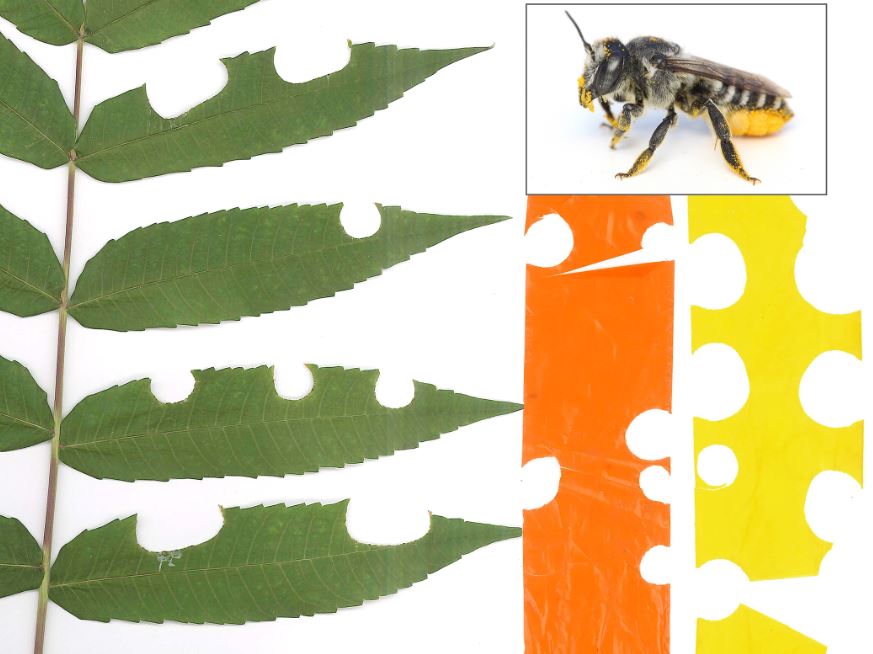
Evidence of leafcutter bees (Megachile) using plastic flagging as nesting material
DOI:
https://doi.org/10.17161/jom.vi144.24911Abstract
Leafcutter bees (Megachile Latreille) occasionally cut anthropogenic plastics in addition to natural leaves used for nest construction. We document new observations of bees cutting yellow and orange plastic flagging and compare the visual reflectance of plastics with that of commonly used leaves. Reflectance patterns showed clear differences between plastics and leaves, suggesting that plastic use is unlikely to be driven by visual similarity and may instead represent opportunistic or maladaptive behavior.
References
Allasino, M.L., H.J. Marrero, J. Dorado, & J.P. Torretta. 2019. Scientific note: first global report of a bee nest built only with plastic. Apidologie 50(2): 230–233. https://doi.org/10.1007/s13592-019-00635-6
Bergstrand, K.J., L.M. Mortensen, A. Suthaparan, & H.R. Gislerød. 2016. Acclimatisation of greenhouse crops to differing light quality. Scientia horticulturae 204:1–7. https://doi.org/10.1016/j.scienta.2016.03.035
Chittka, L., & N.E. Raine. 2006. Recognition of flowers by pollinators. Current opinion in plant biology 9(4): 428–435. https://doi.org/10.1016/j.pbi.2006.05.002
Eickwort, G.C., R.W. Matthews, & J. Carpenter. 1981. Observations on the nesting behavior of Megachile rubi and M. texana with a discussion of the significance of soil nesting in the evolution of megachilid bees (Hymenoptera: Megachilidae). Journal of the Kansas Entomological Society 54(3): 557–570. https://www.jstor.org/stable/25084194
Gess, S.K., & P.A. Roosenschoon. 2017. Notes on the nesting of three species of Megachilinae in the Dubai Desert Conservation Reserve, UAE. Journal of Hymenoptera Research 54: 43–56. https://doi.org/10.3897/jhr.54.11290
Kambli̇, S.S., M. Aiswarya, K. Manoj, S. Varma, G. Asha, T. Rajesh, & P.A. Sinu. 2017. Leaf foraging sources of leafcutter bees in a tropical environment: implications for conservation. Apidologie 48(4): 473–482. https://doi.org/10.1007/s13592-016-0490-2
MacIvor, J.S., & A.E. Moore. 2013. Bees collect polyurethane and polyethylene plastics as novel nest materials. Ecosphere 4(12): 1–6. https://doi.org/10.1890/ES13-00308.1
Michener, C.D., 2007. The Bees of the World [2nd Edition]. Johns Hopkins University Press; Baltimore, MD; xvi+[i]+953 pp., +20 pls.
Pitts-Singer, T.L., & J.H. Cane. 2011. The alfalfa leafcutting bee, Megachile rotundata: the world's most intensively managed solitary bee. Annual review of entomology 56(1): 221–237. https://doi.org/10.1146/annurev-ento-120709-144836
Sinu, P.A., & J.L. Bronstein. 2018. Foraging preferences of leafcutter bees in three contrasting geographical zones. Diversity and Distributions 24(5): 621–628. https://doi.org/10.1111/ddi.12709
Stephen, W., & R. Every. 1970. Nesting media for the propagation of leaf cutter bees. Fact Sheet 175, Oregon State University Cooperative Extension Service; Corvallis, OR; 2 pp.
Torretta, J.P., S.P. Durante, M.G. Colombo, & A.M. Basilio. 2012. Nesting biology of the leafcutting bee Megachile (Pseudocentron) gomphrenoides (Hymenoptera: Megachilidae) in an agro-ecosystem. Apidologie 43(6): 624–633. https://doi.org/10.1007/s13592-012-0137-x
Wilson, J.S., & O.J.M. Carril. 2015. The Bees in Your Backyard: A Guide to North America's Bees. Princeton University Press, Princeton, NJ; 288 pp.
Downloads
Published
Issue
Section
License
Copyright (c) 2026 Joseph S Wilson, Sussy I. Alvarez Merino, Scott McCleve, Olivia Messinger Carril

This work is licensed under a Creative Commons Attribution-NonCommercial-NoDerivatives 4.0 International License.
Copyright for articles published in Journal of Melittology is retained by the authors, with first publication rights granted to the journal. By virtue of their appearance in this open access journal, articles are free to use, with proper attribution and permission of the authors, in educational and other non-commercial settings.