
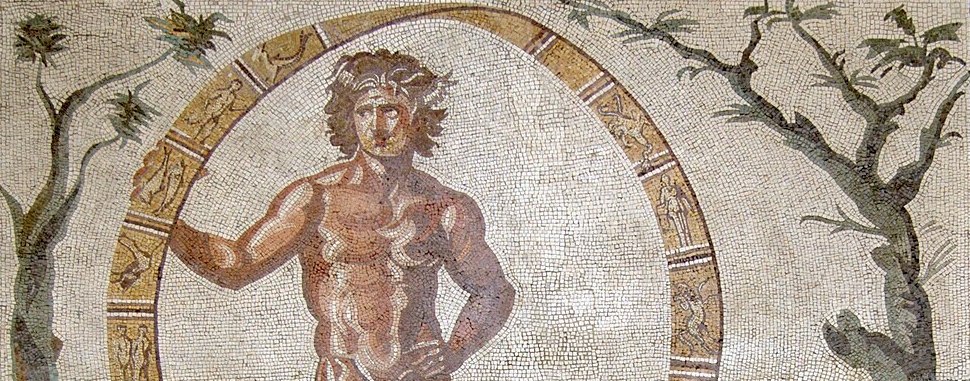
Aion, God of Eternity, standing in a mobius strip decorated with signs of the Zodiac. The goddess Tellus and her four children recline at his feet, Roman floor mosaic, Sentinum, c. 200–300 AD

About the Journal

Aion. Journal of Philosophy and Science is an international, open-access and peer-reviewed journal hosted and published by the University of Kansas Libraries.

The journal is committed to publishing original and relevant research in the areas of Philosophy and Science. It thus accepts philosophical papers motivated by scientific research as well as scientific papers dealing with philosophical problems. Aion also accepts articles dealing with new problems, areas and topics of philosophical and scientifically motivated research as well as with concepts of major philosophical significance in our time.

Beyond European and North American philosophy, Aion aims at establishing constructive relationships with African, Asian, Australian and South American philosophical communities. 

The journal does not have article processing charges (APCs) nor article submission charges.

Announcements

Coming in 2026: Issue 3, 'Where are the Technologies of the Future? From Simondon to Science Fiction.'
2025-12-09
Submissions are complete for Issue 3, a guest-edited issue on the theme ‘Where are the Technologies of the Future? From Simondon to Science Fiction.’ Submissions for Issue 4 will open soon.

About Issue 3:
'Where are the Technologies of the Future?  From Simondon to Science Fiction.'

“Advanced technology must learn not only to invent the new, but to reintegrate the old and update it in order to make it a present under the call of the future.”

Gilbert Simondon, 1983

Beyond ephemeral promises, forty years after Gilbert Simondon invoked the “call of the future,” reflection on the fate of our civilization faces shared evidence: the technologies capable of meeting the major challenges ahead — whether material, energetic, informational, or environmental — are not reduced to the futuristic appearances of the accelerated innovations that have marked recent decades. Far from resembling a blind race for novelty, it is above all technologies capable of laying the foundation for a less ephemeral future — for both living beings and machines within their intertwined environments — that should capture our attention.

This necessity demands a profound reorientation of contemporary thought, which must now rely on the convergence of diverse disciplines, ranging from the philosophy of technology to the practice of “science-fiction prototyping,” through the natural and human sciences, design methods, knowledge management, and ecological redirection. The goal is to move beyond the disorientation born from abandoning linear representations of technical progress, in order to develop a more complex and nuanced understanding of technological trajectories.

Read more about Coming in 2026: Issue 3, 'Where are the Technologies of the Future? From Simondon to Science Fiction.'

Current Issue

Issue 3, 2026: "Where are the Technologies of the Future? From Simondon to Science Fiction"
					View Issue 3, 2026: "Where are the Technologies of the Future? From Simondon to Science Fiction"

In 1983, Gilbert Simondon argued that “a deepend technology must learn not only to invent the new but also to reinsert the old and update it in the present under the call of the future.” In an era defined by artificial intelligence, energy crises, climate change, and the shift toward cognitive warfare, philosophers must develop new criteria for rethinking progress in all its dimensions, moving beyond our obsession with power, and embracing the risks of science fiction, in order to restore a less ephemeral future, for both technological concretizations and the individuations of living beings.

Published: 2026-10-08

Full Issue

Articles

View All Issues