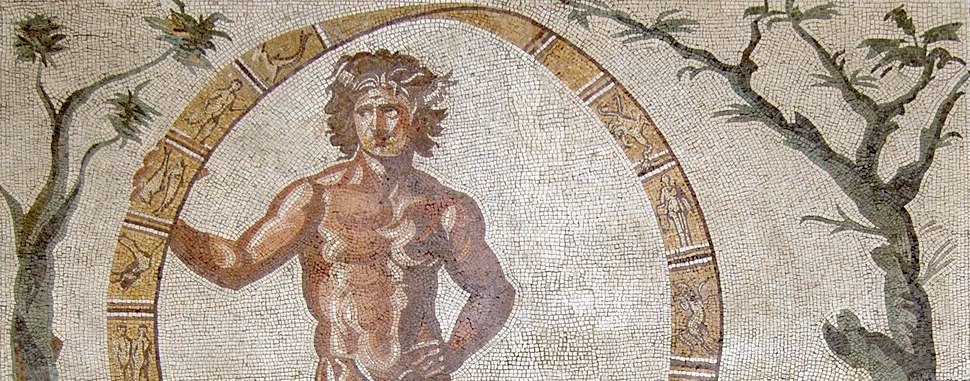
Aion, God of Eternity, standing in a mobius strip decorated with signs of the Zodiac. The goddess Tellus and her four children recline at his feet, Roman floor mosaic, Sentinum, c. 200–300 AD

Sobre a Revista

Aion. Journal of Philosophy and Science is an international, open-access and peer-reviewed journal hosted and published by the University of Kansas Libraries.

The journal is committed to publishing original and relevant research in the areas of Philosophy and Science. It thus accepts philosophical papers motivated by scientific research as well as scientific papers dealing with philosophical problems. Aion also accepts articles dealing with new problems, areas and topics of philosophical and scientifically motivated research as well as with concepts of major philosophical significance in our time.

Beyond European and North American philosophy, Aion aims at establishing constructive relationships with African, Asian, Australian and South American philosophical communities. 

The journal does not have article processing charges (APCs) nor article submission charges.

Notícias

Call for Papers, 4th issue: Human Intelligence and Artificial Intelligence

2026-03-12

Aion. Journal of Philosophy & Science invites submissions for an issue dedicated to the philosophical exploration of the theme Human Intelligence and Artificial Intelligence (AI).

The emergence of AI is not merely a technological event; it is a transformation of the conditions under which intelligence appears and operates. For the first time, we are facing artifacts that seem to be intelligent, capable of solving problems, learning, deciding, creating, reasoning, thinking. For the first time, we face artefacts that do not simply extend human capacities but seem to rival them, displace them, or reconfigure them.

Intelligence — long considered a crucial trait of the human — now becomes a property of systems that are neither biological nor conscious, neither embodied nor mortal. This raises questions that cut across metaphysics, ethics, epistemology, political philosophy, and the philosophy of mind. Questions that challenge the inherited distinctions between the natural and the artificial, the human and the technical, the organic and the computational.

This issue aims to bring together diverse perspectives that illuminate the conceptual, epistemological, ethical, political, artistical and metaphysical questions raised by the problematic coexistence — and possible conflict or convergence — of human and artificial forms of intelligence.

These questions do not belong to any single tradition. They resonate across the history of philosophy and its various lines — from continental to Anglo-American thought — yet they demand the invention of new conceptual tools capable of addressing the unprecedented transformations introduced by AI into the human–technical relation. We believe that it is therefore intellectually fruitful to turn to thinkers who are not traditionally invoked in debates on human and artificial intelligence, but whose thinking can open unexpected routes.

We thus welcome original contributions addressing, but not limited to, the following themes:

  • What is truly at stake when intelligence is externalized, when it becomes automated and autonomous? What becomes of intelligence when cognitive functions are externalized, automated, or surpassed?
  • Can we still speak of intelligence in the singular, or must we acknowledge a plurality of intelligences—organic, artificial, distributed, collective?
  • How to conceptualize work, action, responsibility, in a world where thinking is distributed across human and artificial systems?
  • If intelligence is distributed across human and non-human actors, how might we rethink the political framework of a community?
  • What does it mean for us to think in the presence of AI systems that increasingly think in our place?
  • Does AI expose the fragility of the human or does it announce a new figure of the human - augmented, hybrid, post-biological?

This issue invites contributions that engage these — and other —questions with philosophical rigor and imaginative depth. The aim is to revisit classical questions — about intelligence, mind, knowledge, embodiment, technicity, ethics, politics, the future of human existence — under new conditions. Above all, it seeks to rediscover what human intelligence might mean in an age of artificial intelligences.

The editors

Saiba mais sobre Call for Papers, 4th issue: Human Intelligence and Artificial Intelligence

Edição Atual

Issue 2, 2025: "Imagination"
Mosaic of the Greek god Aion on a brown background

Few concepts in the history of philosophy or science are as rich, polysemic and mysterious as imagination.  That “art concealed in the depths of the human soul” as Kant said, is indeed a fundamental concept in philosophy, namely in philosophy of knowledge, logic, metaphysics, philosophy of science, modal epistemology, aesthetics, philosophy of art, ethics, social and political philosophy, philosophy of mind and so on. 

Publicado: 2025-12-09

Edição completa

Ver Todas as Edições