
Unusual nesting habits, floral associations, and natural enemies of the Neotropical leaf-cutter bee Megachile exaltata Smith (Hymenoptera: Megachilidae)
DOI:
https://doi.org/10.17161/jom.vi138.24800Abstract
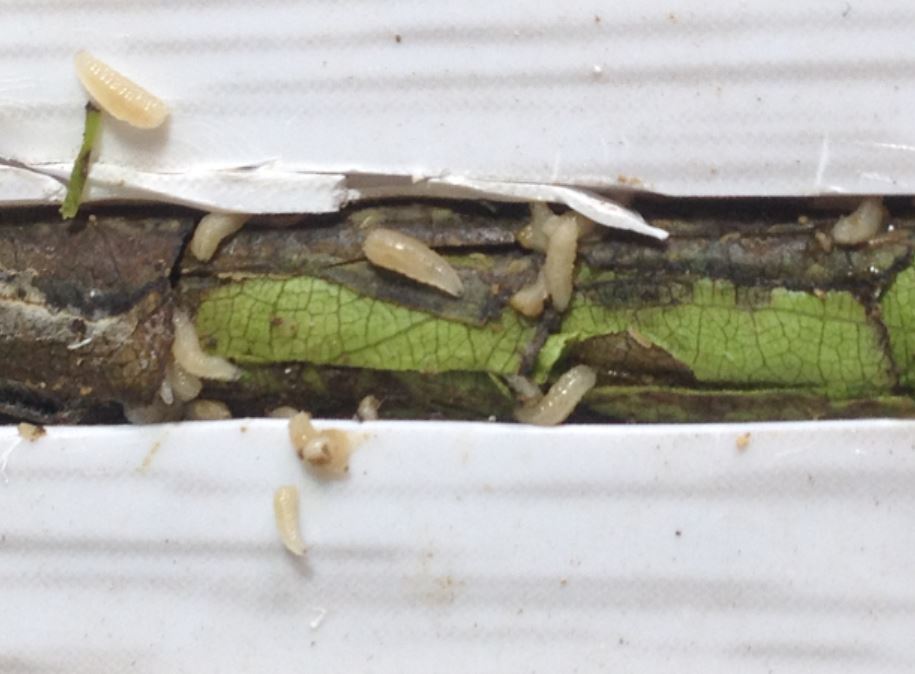
Leaf-cutter bees (genus Megachile Latreille) represent a diverse group whose biology remains poorly documented, especially in the tropics. Here, we describe the nesting behavior, cell morphology, floral associations, and natural enemies of Megachile (Austromegachile) exaltata Smith, based on nests found in Western Costa Rica. Brood cells were built entirely from leaf pieces of Euphorbia (Chamaesyce) (Euphorbiaceae), and many were built in the open, rather than within pre-existing cavities. These exposed cells were placed among a wide range of man-made objects, such as umbrellas, plastic panels, black plastic bags, and even clothing. Bees also nested in pre-existing cavities, such as crevices, bamboo canes, and abandoned nests of black mud dauber wasps (Sphecidae: Sceliphron spp.). Palynological analyses of brood provisions showed that pollen consisted exclusively of Muntingia calabura L. (Muntingiaceae), a widely distributed Neotropical shrub or tree, indicating monofloral foraging. Brood cells were parasitized by the cuckoo bee Coelioxys otomita Cresson, parasitic wasps (Chalcididae: Brachymeria sp.), and phorid flies [Phoridae: Megaselia scalaris (Loew)]. These findings expand our understanding of the nesting plasticity and ecological interactions of Neotropical leaf cutter bees.
References
Allasino, M.L., H.J. Marrero, J. Dorafo, & J.P. Torretta. 2019. First global report of a bee nest built only with plastic. Apidologie 50: 230–233. http://dx.doi.org/10.1007/s13592-019-00635-6
Buschini, M.L.T., Rigon, J., & J. Cordeiro. 2009. Plants used by Megachile (Moureapis) sp. (Hymenoptera: Megachilidae) in the provisioning of their nests. Brazilian Journal of Biology 69(4): 1187–1194. https://doi.org/10.1590/S1519-69842009000500025
Frankie, G.W., Vinson, S.B., Rizzardi, M.A., Griswold, T.L., Coville, R.E., Grayum, M.H., Martinez, L.E.S., Foltz-Sweat, J., & J.C. Pawelek. 2013. Relationships of bees to host ornamental and weedy flowers in urban northwest Guanacaste Province, Costa Rica. Journal of the Kansas Entomological Society 86(4): 325–351. http://www.jstor.org/stable/43288257
Gonzalez, V.H., Griswold, T.L. & M.S. Engel. 2018. South American leaf-cutter bees (Genus Megachile) of the subgenera Rhyssomegachile and Zonomegachile, with two new subgenera (Hymenoptera: Megachilidae). Bulletin of the American Museum of Natural History 425: 1–75. https://doi.org/10.1206/00030090-425.1.1
Gonzalez, V.H., Gustafson, G. & M.S. Engel. 2019. Morphological phylogeny of Megachilini and the evolution of leaf-cutter behavior in bees (Hymenoptera: Megachilidae). Journal of Melittology 85: 1–123. https://doi.org/10.17161/jom.v0i85.11541
Kim, J. 1992. Nest dimensions of two leaf-cutter bees (Hymenoptera: Megachilidae). Annals of the Entomological Society of America 85(1): 85–90. https://doi.org/10.1093/aesa/85.1.85
Krombein, K.V. & B.B. Norden. 1995. Notes on the behavior and taxonomy of Megachile (Xeromegachile) brimleyi Mitchell and its probable cleptoparasite, Coelioxys (Xerocoelioxys) galactiae Mitchell (Hymenoptera: Megachilidae). Proceedings of the Entomological Society of Washington 97(1): 86–89.
Laroca, S., Filho, D.L., & F. Zanella. 1987. Ninho de Austromegachile habilis e notas sobre a diversidade de Megachile (Apoidea, Megachilidae) em biótopos neotropicais. Acta Biologia Paranaense, Curitiba 16(1–4): 93–105. https://doi.org/10.5380/abpr.v16i0.812
MacIvor, J.S., & A.E. Moore. 2013. Bees collect polyurethane and polyethylene plastics as novel nest materials. Ecosphere 4(12): 155 [1–6]. https://doi.org/10.1890/ES13-00308.1
Marinho, D., Muniz, D.B., & G.G. Azevedo. 2018. Nesting biology of three Megachile (Hymenoptera: Megachilidae) species from Eastern Amazonia, Brazil. Revista Brasileira de Entomologia 62(2): 97–106. https://doi.org/10.1016/j.rbe.2018.03.002
Medler, J.T. 1965. A note on Megachile mendica Cresson Say in trap-nests in Wisconsin (Hymenoptera: Megachilidae). Proceedings of the Entomological Society of Washington 67(2): 113–116.
Michener, C.D. 2007. The Bees of the World [2nd Edition]. Johns Hopkins University Press; Baltimore, MD; xvi+[i]+953 pp., +20 pls.
Moure, J.S., G.A.R. Melo, & A. DalMolin. 2007. Megachilini Latreille, 1802. In: Moure, J.S., D. Urban, & G.A.R. Melo (Eds.), Catalogue of Bees (Hymenoptera, Apoidea) in the Neotropical Region: 917–1001. Sociedade Brasileira de Entomologia; Curitiba, Brazil; xiv+1058 pp. [https://www.moure.cria.org.br/catalogue; last accessed 2 November 2025].
Müller, A., & N. Bansac. 2004. A specialized pollen-harvesting device in western palaearctic bees of the genus Megachile (Hymenoptera, Apoidea, Megachilidae). Apidologie 35: 329–337. https://doi.org/10.1051/apido:2004020
Müller, A., Weibel, U., & R. Lenz. 2024. A threefold plant specialist – distribution, habitat requirements and nesting biology of the rare leafcutter bee Megachile genalis in the eastern Swiss Alps (Hymenoptera, Megachilidae). Alpine Entomology 8: 131–146. https://doi.org/10.3897/alpento.8.137006
Packer, L. 1987. The triungulin larva of Nemognatha (Pauronemognatha) punctulata LeConte (Coleoptera: Meloidae) with a description of the nest of its host – Megachile brevis pseudobrevis Say (Hymenoptera: Megachilidae). Journal of the Kansas Entomological Society 60(2): 280–287. https://www.jstor.org/stable/25084893
Parker, F.D., & L.A. Stange. 1965. Systematic and biological notes on the tribe Platymantispini (Neuroptera: Mantispidae) and the description of a new species of Plega from Mexico. The Canadian Entomologist 97(6): 604–612. https://doi.org/10.4039/Ent97604-6
Pitts-Singer, T.L., & J.H. Cane. 2011. The alfalfa leafcutting bee, Megachile rotundata: The world’s most intensively managed solitary bee. Annual Review of Entomology 56: 221–237. https://doi.org/10.1146/annurev-ento-120709-144836
POWO. 2025. Plants of the World Oline. Facilitated by the Royal Botanic Garderns, Kew. Published on the internet; https://powo.science.kew.org/ Retrieved 10 December 2025.
Ricchiuti, L., Miranda, M., Venti, R., Bosi, F., Marino, L., & F. Mutinelli. 2016. Infestation of Apis mellifera colonies by Megaselia scalaris (Loew, 1866) in Abruzzo and Molise regions, central-southern Italy. Journal of Apicultural Research 55(2): 187–192. https://doi.org/10.1080/00218839.2016.1196017
Rossi, F., Iannitto, M., Hulaj, B., Manocchio, P., Gentile, F., Matto, I. D., Paoletti, M., Marino, L., & L. Ricchiuti. 2024. Megaselia scalaris and Senotainia tricuspis infesting Apis mellifera: Detection by quantitative PCR, genotyping, and involvement in the transmission of microbial pathogens. Insects 15(10): 786. https://doi.org/10.3390/insects15100786
Roubik, D.W., & J.E. Moreno. 1991. Pollen and Spores of Barro Colorado Island. Monographs in Systematic Botany from the Missouri Botanical Garden. Missouri Botanical Garden; St Louis, MO; Vol. 36, 270 pp+97 pls.
Sheffield, C.S. 2017. Unusual nesting behavior in Megachile (Eutricharaea) rotundata (Hymenoptera: Megachilidae). Journal of Melittology 69: 1–6. https://doi.org/10.17161/jom.v0i69.6532
Soh, E.J.Y., Soh, Z.W.W. Chui, S.X., & J.S. Ascher. 2016. The bee tribe Anthidiini in Singapore (Anthophila: Megachilidae: Anthidiini) with notes on the regional fauna. Nature in Singapore 9: 49–62. https://lkcnhm.nus.edu.sg/app/uploads/2017/06/2016nis049-062.pdf
Williams, H.J., Strand, M.R., Elzen, G.W., Vinson, S.B., & S.J. Merritt. 1986. Nesting behavior, nest architecture, and use of Dufour’s gland lipids in nest provisioning by Megachile integra and M. mendica mendica (Hymenoptera: Megachilidae). Journal of the Kansas Entomological Society 59(4): 588–597. https://www.jstor.org/stable/25084832
Wilson, J.S., Jones, S.I., McCleve, S., & O.M. Carril. 2024. Evidence of leaf-cutter bees using plastic flagging as nesting material. [accessed on 10/31/2025: https://www.beesinyourbackyard.com/post/evidence-of-leaf-cutter-bees-using-plastic-flagging-as-nesting-material]
Downloads
Additional Files
Published
Issue
Section
License
Copyright (c) 2025 Ingrid Aguilar-Monge, Eduardo Herrera, Luis A. Sánchez, Victor H. Gonzalez

This work is licensed under a Creative Commons Attribution-NonCommercial-NoDerivatives 4.0 International License.
Copyright for articles published in Journal of Melittology is retained by the authors, with first publication rights granted to the journal. By virtue of their appearance in this open access journal, articles are free to use, with proper attribution and permission of the authors, in educational and other non-commercial settings.