Announcing a new section: Provisional Identification Keys
DOI:
https://doi.org/10.17161/jom.vi147.25551Abstract
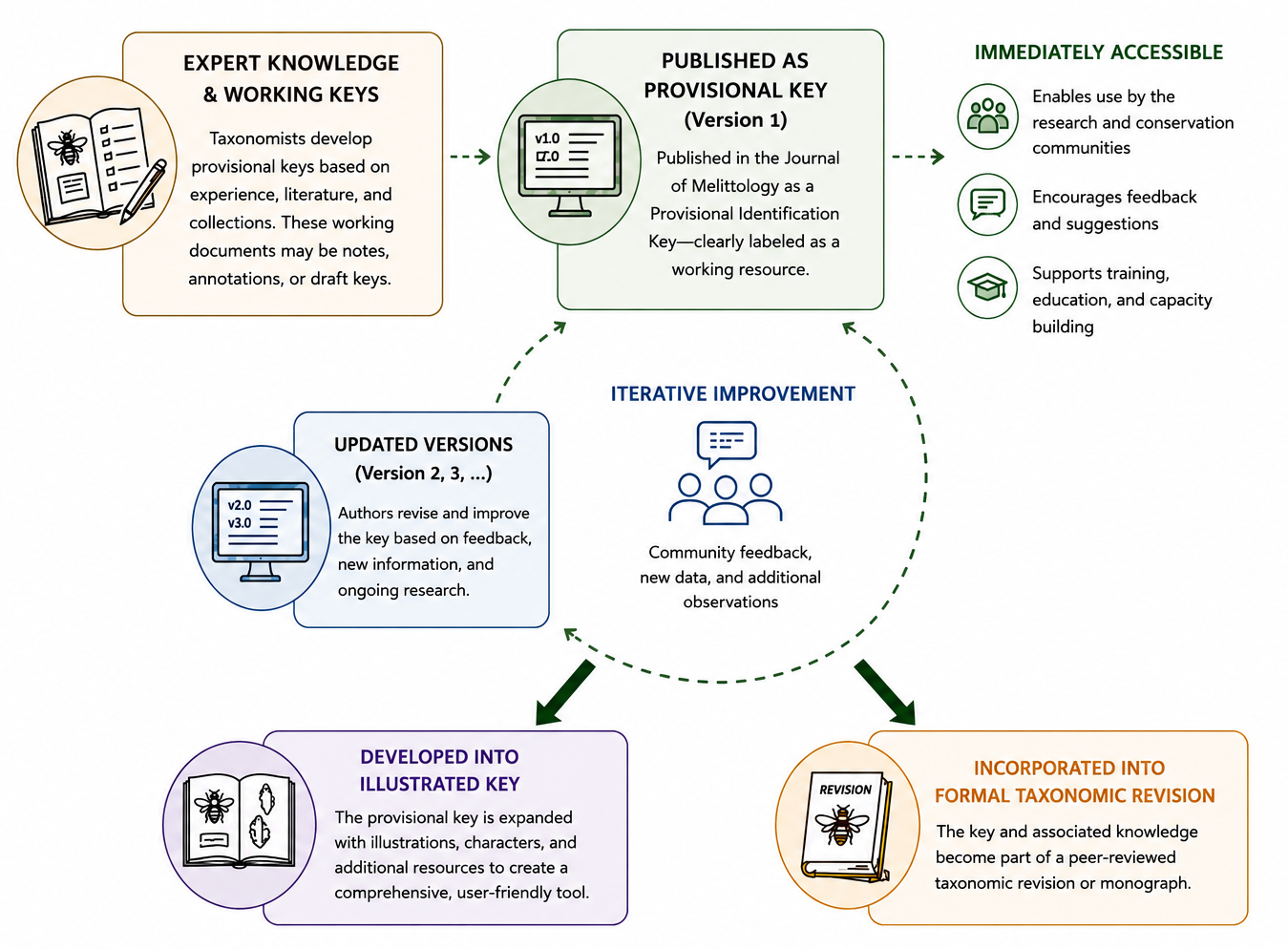
Accurate species identification is essential for research, monitoring, human and animal health, agriculture, and conservation, yet it is often hindered by outdated or inaccessible identification keys and a limited number of trained taxonomists. Many experts maintain provisional keys that are actively used for identification but remain unpublished because these are not part of a taxonomic revision, lack illustrations, are incomplete, or are simply not sufficient to merit a stand-alone, peer-reviewed publication. To enable access to such keys, the Journal of Melittology introduces a new section, Provisional Identification Keys, dedicated to the dissemination of draft, preliminary, or provisional keys for bees. These contributions will be available online as clearly labeled working resources to facilitate identification, preserve expert knowledge, support training, facilitate and encourage collaborations and complement, rather than replace, formal, peer-reviewed taxonomic revisions. We will further clarify the nature of the complementarity in this introductory article.
References
Andreola, M.F., V.H. Gonzalez, & T. Griswold. 2026. Key to the species of Augochloropsis Cockerell (Halictidae: Augochlorini) from Panama and Costa Rica. Version 1.0. Journal of Melittology, Provisional Identification Keys. 148: 1–5. https://doi.org/10.17161/jom.vi148.25560
Elmore, S.A. 2018. Preprints: What role do these have in communicating scientific results? Toxicologic Pathology 46(4): 364–365. https://doi.org/10.1177/0192623318767322
Engel, M.S., Ceríaco, L.M.P., Daniel, G.M., et al., 2021. The taxonomic impediment: A shortage of taxonomists, not the lack of technical approaches. Zoological Journal of the Linnean Society 193(2): 381–387. https://doi.org/10.1093/zoolinnean/zlab072
Fraser, N., F. Momeni, P. Mayr, & I. Peters. 2020. The relationship between bioRxiv preprints, citations and altmetrics. Quantitative Science Studies 1(2): 618–638. https://doi.org/10.1162/qss_a_00043
Gonzalez, V.H., T. Griswold, & M.S. Engel. 2013. Obtaining a better understanding of native bees: Where do we start? Systematic Entomology 38(4): 645–653. https://doi.org/10.1111/syen.12029
Johnston, M., R.L. Aalbu, & N. Franz. 2018. An updated checklist of the Tenebrionidae sec. Bousquet et al. 2018 of the Algodones Dunes of California, with comments on checklist data practices. Biodiversity Data Journal 6: e24927. https://doi.org/10.3897/BDJ.6.e24927
Packer, L., J. Gibbs, C. Sheffield, & R. Hanner. 2009. DNA barcoding and the mediocrity of morphology. Molecular Ecology Resources 9(s1): 42–50. https://doi.org/10.1111/j.1755-0998.2009.02631.x
Walter, D.E., & S. Winterton. 2007. Keys and the crisis in taxonomy: Extinction or reinvention. Annual Review of Entomology 52: 193–208. https://doi.org/10.1146/annurev.ento.51.110104.151054
Woodard, S.H., & H.K. Levenson. 2025. Special issue series: Advancing wild bee research and conservation through standardized methods. Journal of Melittology 123(1): 1–3. https://doi.org/10.17161/jom.vi123.22605
Woodard, S.H, S. Federman, R.R. James, B.N. Danforth, T.L. Griswold, D. Inouye, Q.S. McFrederick, L. Morandin, D.L. Paul, E. Sellers, J.P. Strange, M. Vaughan, N.M. Williams, M.G. Branstetter, C.T. Burns, J. Cane, A.B. Cariveau, D.P. Cariveau, A. Childers, C. Childers, D.L. Cox-Foster, E.C. Evans, K.K. Graham, K. Hackett, K.T. Huntzinger, R.E. Irwin, S. Jha, S. Lawson, C. Liang, M.M. López-Uribe, A. Melathopoulos, H.M.C. Moylett, C.R.V. Otto, L.C. Ponisio, L.L. Richardson, R. Rose, R. Singh, & W. Wehling. 2020. Towards a U.S. national program for monitoring native bees. Biological Conservation 252: 108821. https://doi.org/10.1016/j.biocon.2020.108821
Downloads
Additional Files
Published
Issue
Section
License
Copyright (c) 2026 Victor H. Gonzalez, Claus Rasmussen, Mariano Lucia, Wyatt J. Zabinski

This work is licensed under a Creative Commons Attribution-NonCommercial-NoDerivatives 4.0 International License.
Copyright for articles published in Journal of Melittology is retained by the authors, with first publication rights granted to the journal. By virtue of their appearance in this open access journal, articles are free to use, with proper attribution and permission of the authors, in educational and other non-commercial settings.